

Search Google for almost any product or advice question, and you’ll see Reddit threads in the results. Google ranks Reddit heavily now, and AI tools like ChatGPT and Perplexity cite it constantly as a source.
(In fact, search Google for “reddit keyword research” and you’ll notice that 6 of the top 10 results are actual Reddit threads.)
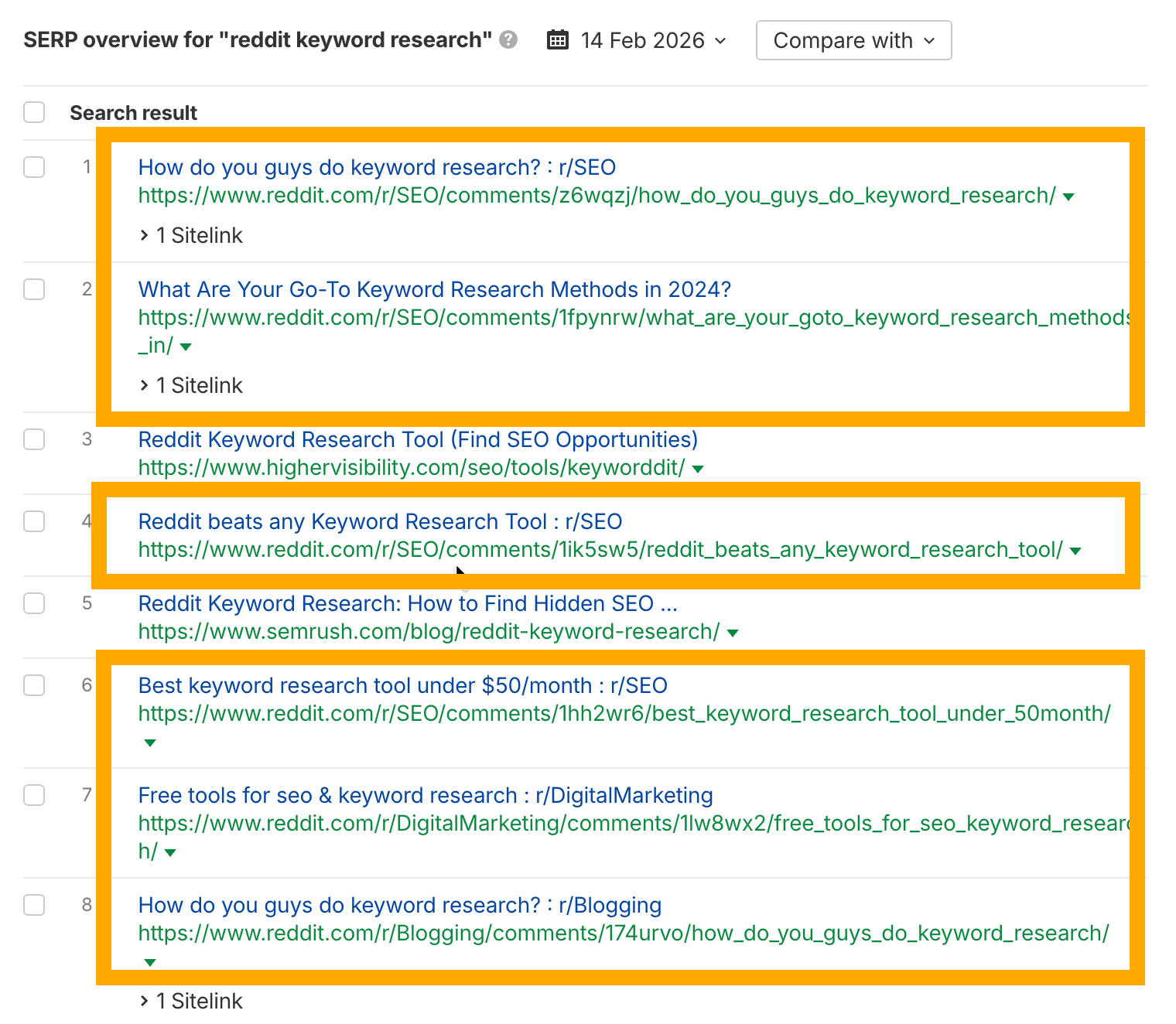
That makes Reddit unique and important. It’s a place where your brand’s reputation is shaped by real user conversations.
And it’s a goldmine of keyword ideas: Reddit shows you the exact language, questions, and pain points real people have. With the right approach, you can find which Reddit discussions already rank in Google and reverse-engineer keyword opportunities from them.
I’ll show you 4 methods I use to extract keyword ideas from Reddit—from quick manual browsing to using Site Explorer to analyze what keywords entire subreddits rank for.
Keyword tools give you concrete search data: volume, difficulty, CPC, search intent. But Reddit gives you the human context.
Take a keyword like “keyword research tools”—4,900 monthly searches, informational intent. That’s useful. But browse the Reddit threads, and you get the full picture: people venting about their current tool, asking for free alternatives, trying to justify a purchase to their boss.
That kind of nuance makes your content better. Reddit adds the perspective, the frustrations, and the exact language that real people use — the stuff that turns a keyword into a content angle.
Take this example: a post in /r/SEO titled “How do you guys do keyword research?” has 42 upvotes and ranks #1 for our target keyword. The thread is full of practitioners sharing their actual workflows, favorite tools, and frustrations with existing options.
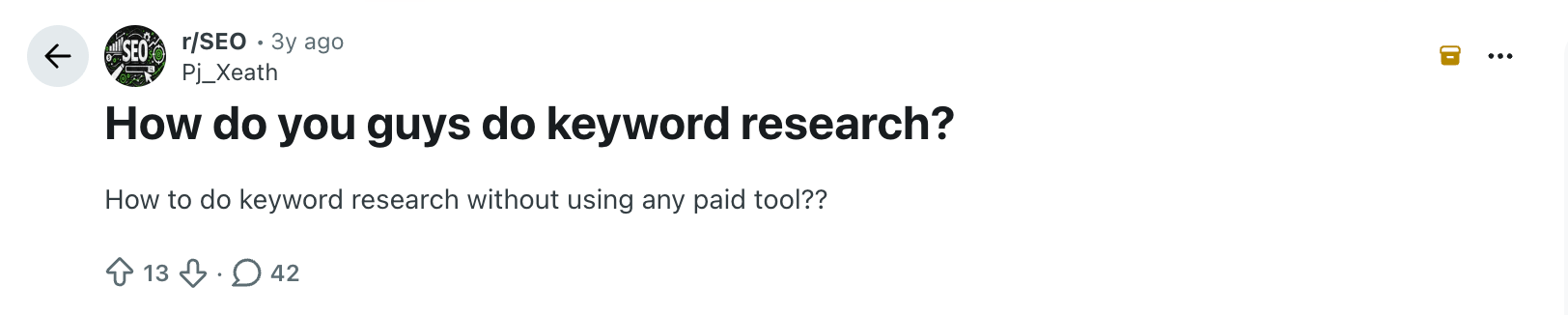
That’s gold for content planning.
You learn that people phrase their problems like “my boss wants me to do SEO but I have no idea where to start”—not “seo beginner guide.” You see which solutions actually resonate (the ones with upvotes) and which fall flat (the ones ignored or downvoted). You discover objections and pain points that surface naturally in discussions.
And more useful still: high engagement on Reddit is a validation signal. If a topic gets 42 upvotes, 15k upvotes, or generates 200 comments, that’s proven interest. It’s not anestimate of what people might search for. It’s evidence of what they actually care about.
Start by searching Google with site:reddit.com [your keyword] to find Reddit discussions (and subreddits) that already rank for your topic:
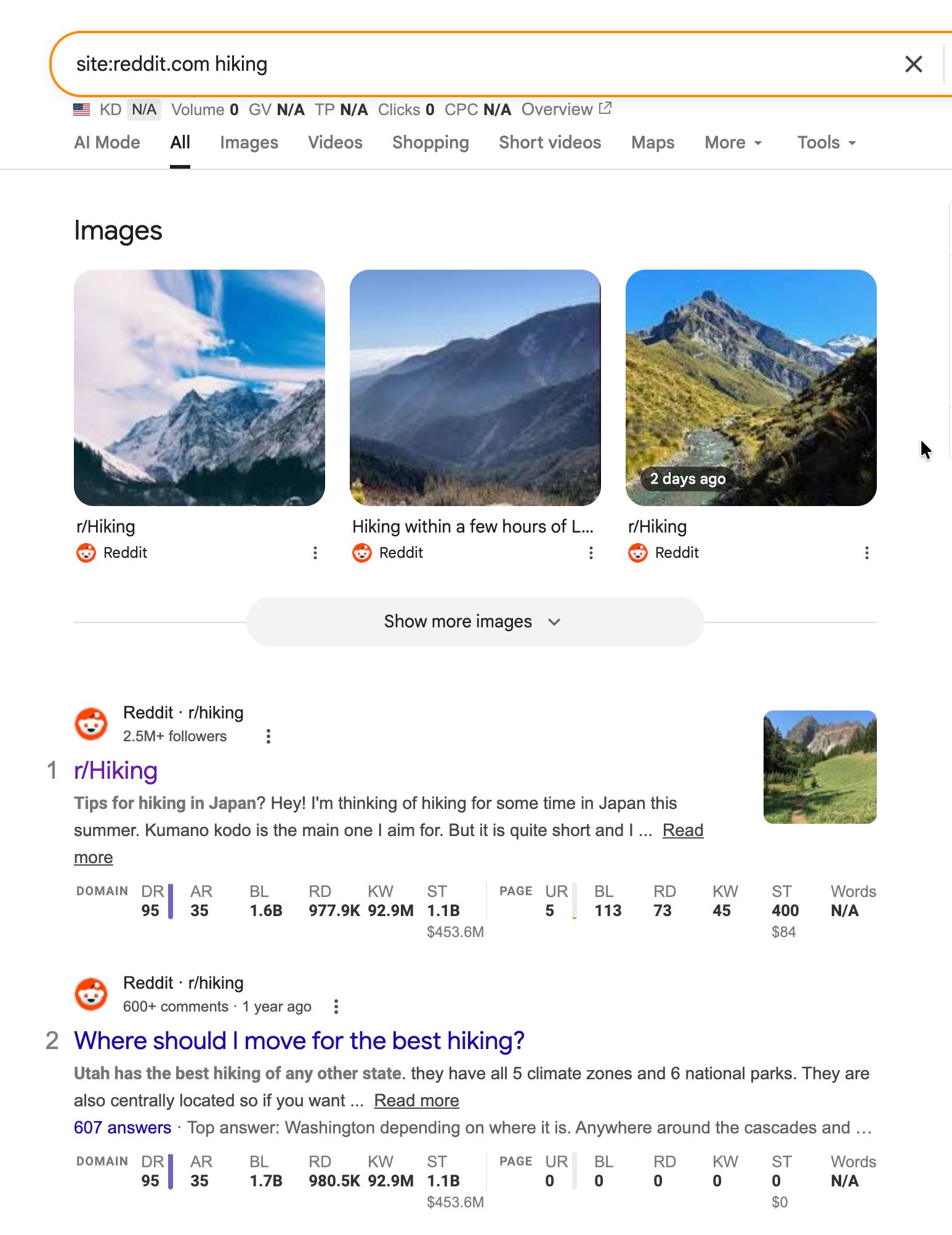
Here are the search operators to use:
site:reddit.com: Find all Reddit discussions Google indexes for this topicsite:reddit.com/r/[subreddit]: Search within a specific communityreddit: See where Reddit naturally ranks for a topic (without thesite:filter)
For example, searching site:reddit.com "best hiking backpack" shows dozens of discussion threads ranking. Each one is packed full of keyword ideas that you could use to shape your next content idea:
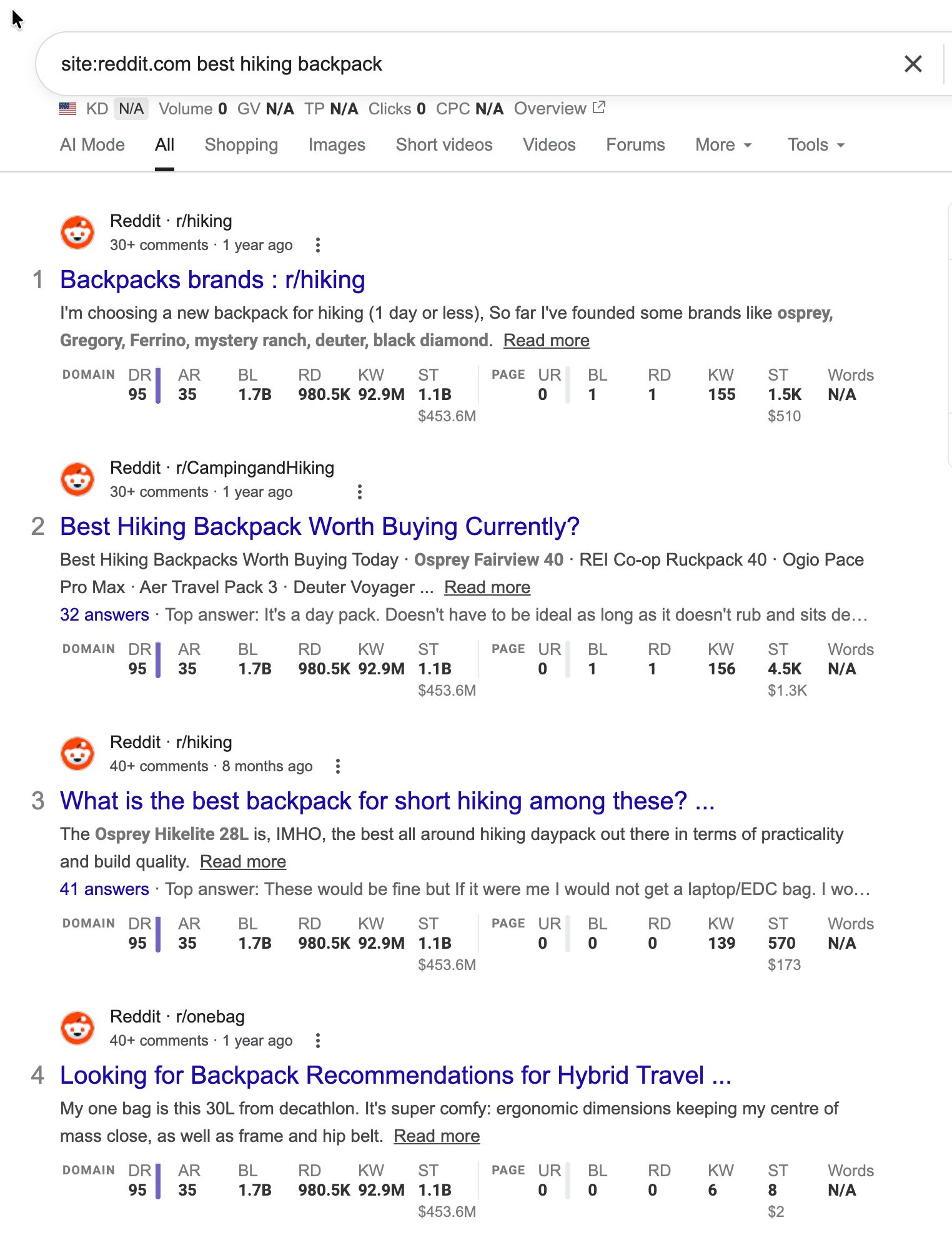
So how do you turn this into actual keyword research?
Start broad and pay attention to how many threads come back. If site:reddit.com "best hiking backpack" returns dozens of results, that tells you there’s real demand and Google trusts Reddit’s answers for it. If site:reddit.com "best hiking backpack for ultralight thru-hiking" returns two, that’s a much thinner opportunity. The density of Reddit results is a rough proxy for demand.
Once you’ve found searches that return plenty of threads, extract the keywords and build a keyword list. Look at thread titles and the queries Google bolds in the snippets: those are the terms Google associates with each result.
What you end up with is a shortlist of keywords where you know three things:
- People are actively discussing the topic.
- Google is surfacing Reddit as an answer.
- There’s (possibly) room for something more comprehensive.
This method is quick and free, but it has real limitations. The site: operator only returns a sample of indexed pages — Google caps results and filters heavily, so you’re seeing a fraction of what actually ranks. You also get no metrics: no search volume, no difficulty score, no traffic estimates.
It’s a good starting point for quick research or a sanity check on a new niche. But if you want the full picture—every keyword a subreddit ranks for, with data attached—you need a different approach.
Pro tip
When you write content for those keywords, share real recommendations, take strong stances, and imbue everything with personal experience. That’s what’s winning for Reddit—and that’s what you need to match or beat.
Here’s something most people don’t realize: you can analyze any subreddit in Site Explorer exactly like you’d analyze a competitor’s website.
Enter reddit.com/r/hiking and you’ll see every keyword that subreddit’s discussions rank for in Google. This is the fastest way to find proven keyword opportunities—if Reddit already ranks, the keyword has traffic potential.
Here’s my process:
- Go to Site Explorer
- Enter a subreddit URL (e.g., reddit.com/r/hiking)
- Click into the Organic keywords report
- Filter by position—top 10 or top 20—to find keywords where Reddit dominates
- Export the keywords where you could create better, more comprehensive content than a scattered discussion thread
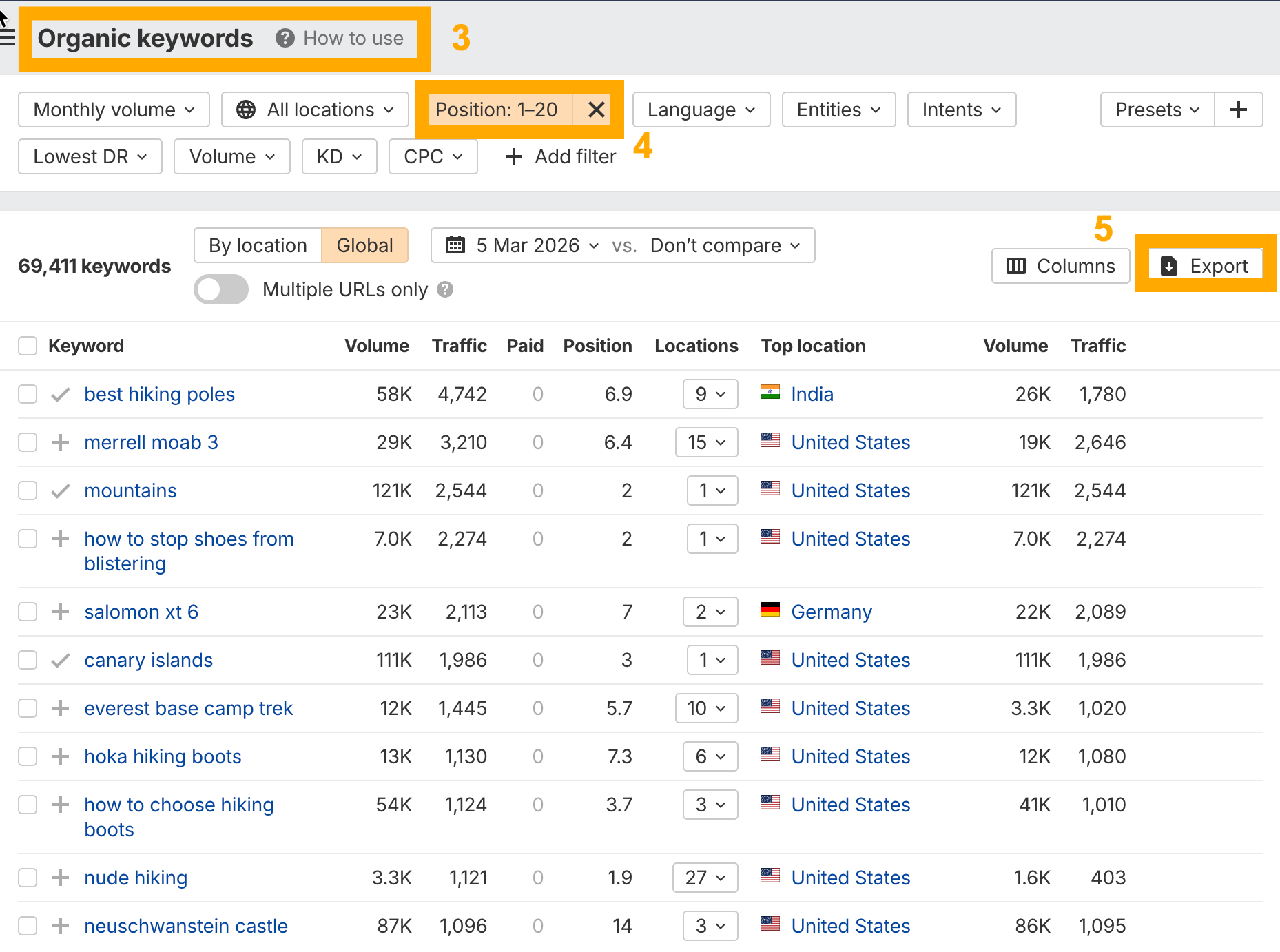
Site Explorer’s Organic keywords report for reddit.com/r/hiking, filtered to positions 1-20. Each keyword here is a proven content opportunity.
Why does this work? Google ranks Reddit discussions because they answer questions authoritatively. Real people sharing real experiences. These are keywords where helpful, experience-based content wins—not just keywords where you need 500 backlinks and a DR 80 domain.
Let me give you a concrete example. When I analyzed /r/hiking in Site Explorer, I found it ranks for almost 80,000 keywords. That includes terms like “best hiking boots for beginners” (2,400 searches/month) and “what to bring on a day hike” (1,900 searches/month).
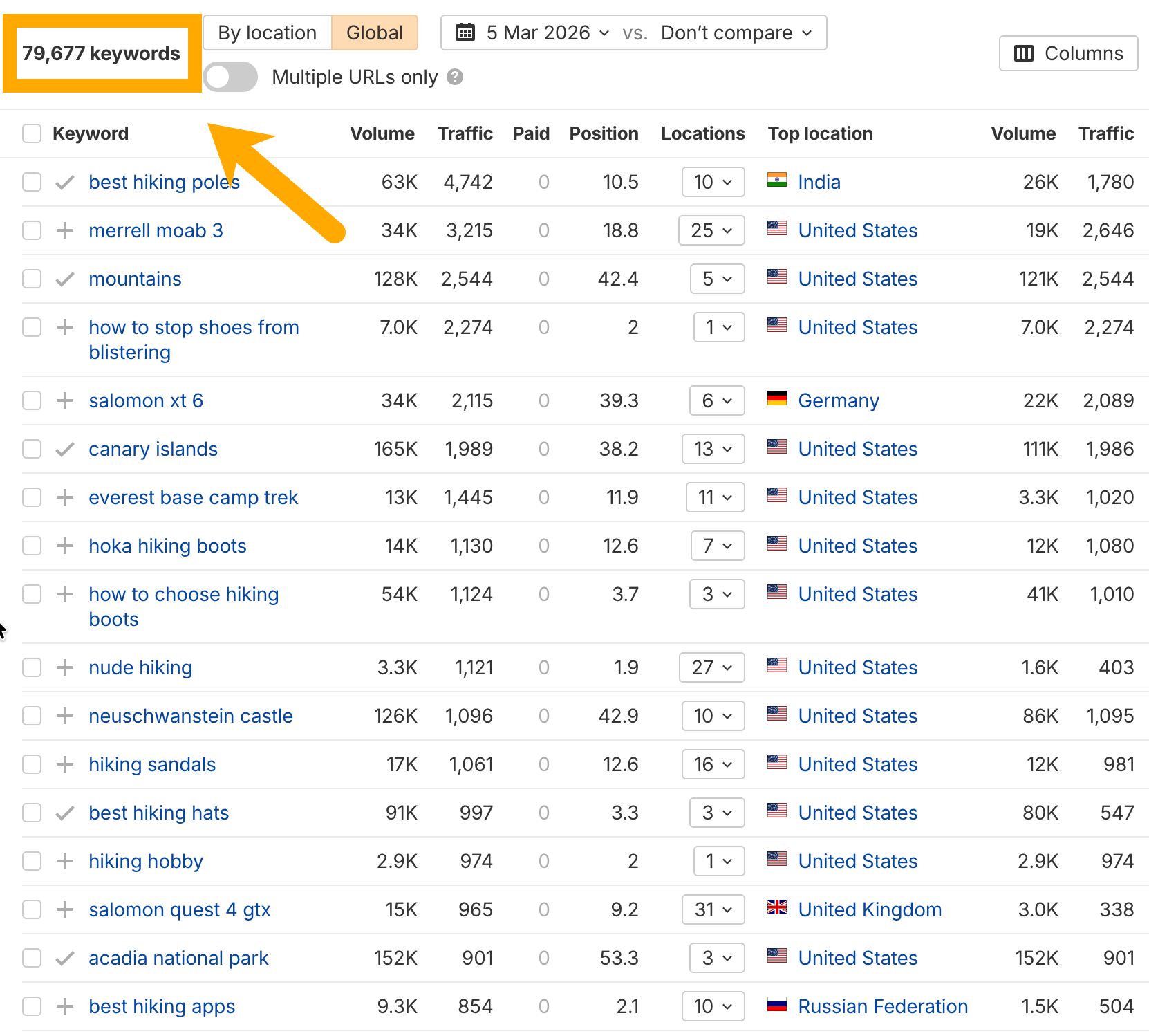
Each one of those keywords is a potential content opportunity.
Pro tip
Look specifically for keywords where Reddit ranks position 3-10.
Position 1-2 means Google loves the Reddit format for this query—the discussion thread is probably the best answer. But position 3-10? That means there’s room for dedicated content that’s more comprehensive, better structured, and easier to scan than a messy comment thread.
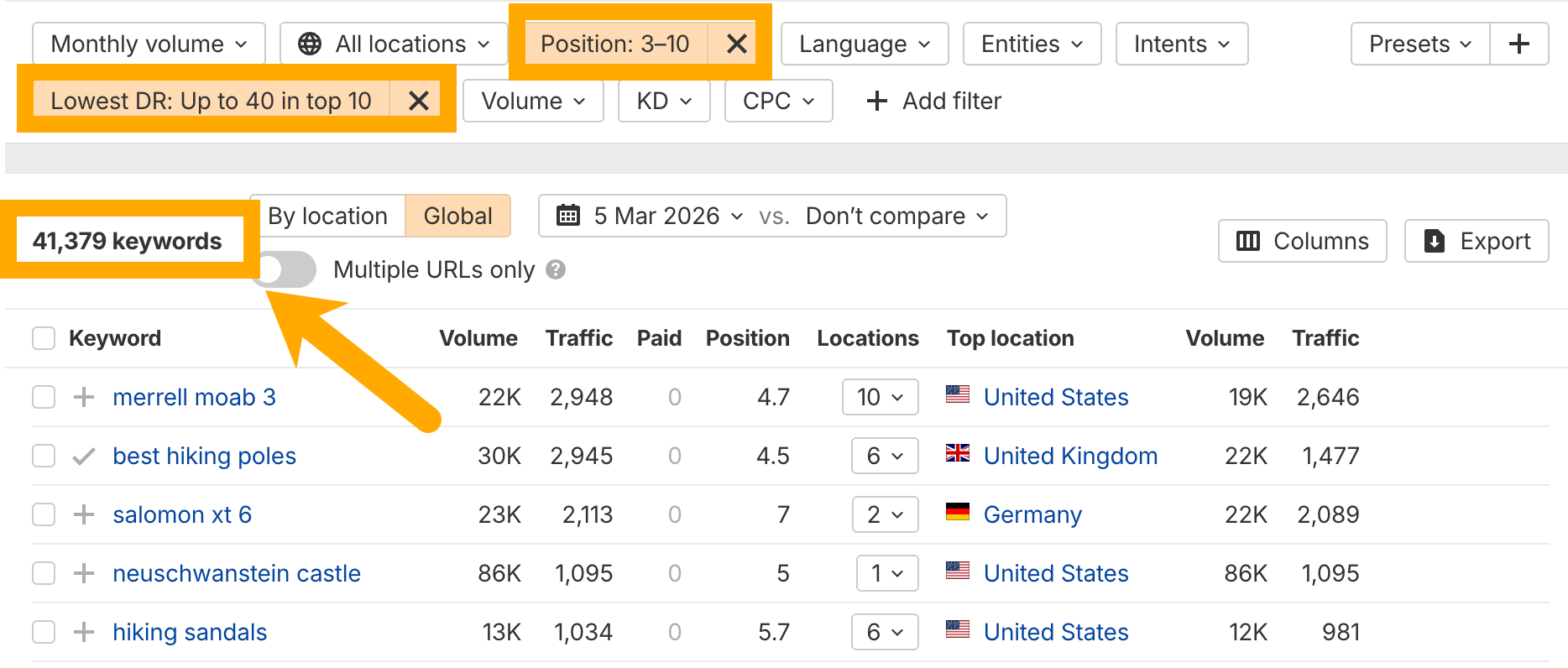
You can also combine filters. To make sure smaller, less authoriative websites can rank for each keyword, I like to filter to keywords that have at least one DR40 (or lower) website ranking in the top 10. Those are your best opportunities.
This is the scrappiest method, but often very insightful.
Browse relevant subreddits sorted by “Top” posts to find the questions and problems your audience cares about most. Upvotes are a built-in validation signal—they tell you which topics resonate with actual people.
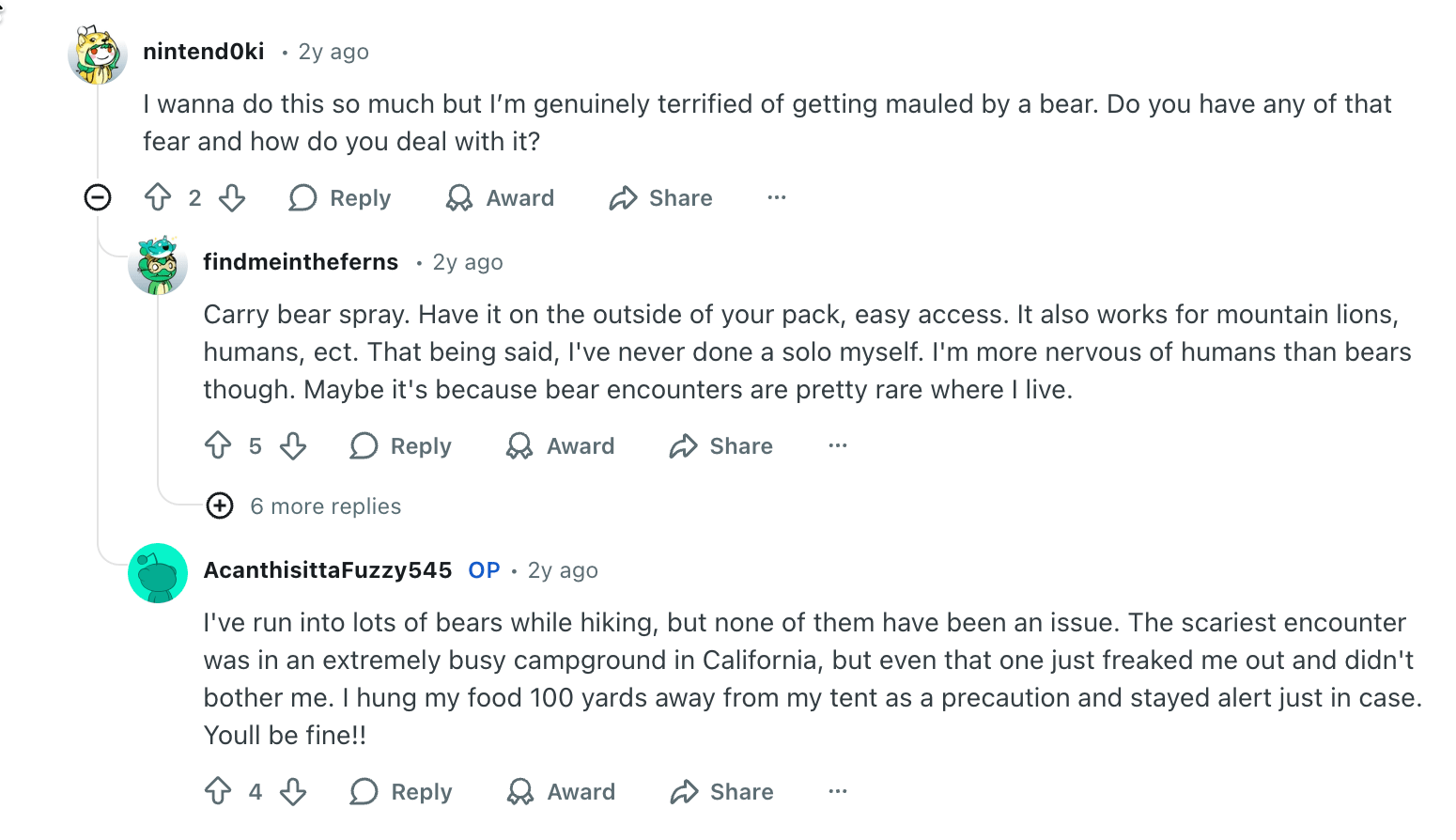
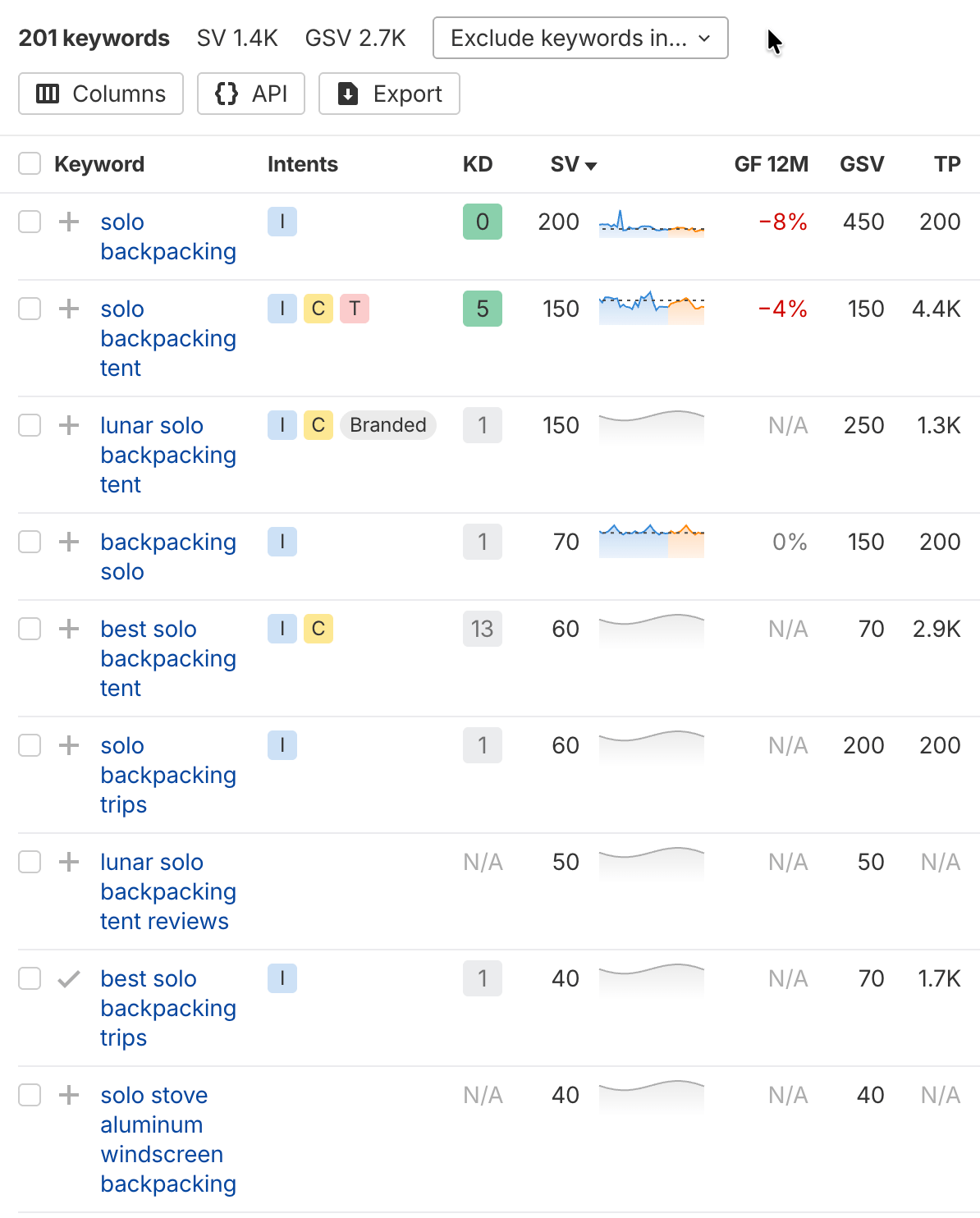
Here’s an example. If I search for “hiking”, r/WildernessBackpacking is one of the most popular subreddits. Searching the subreddit’s top posts, two of the most popular posts cover the same topic: solo backpacking trips.
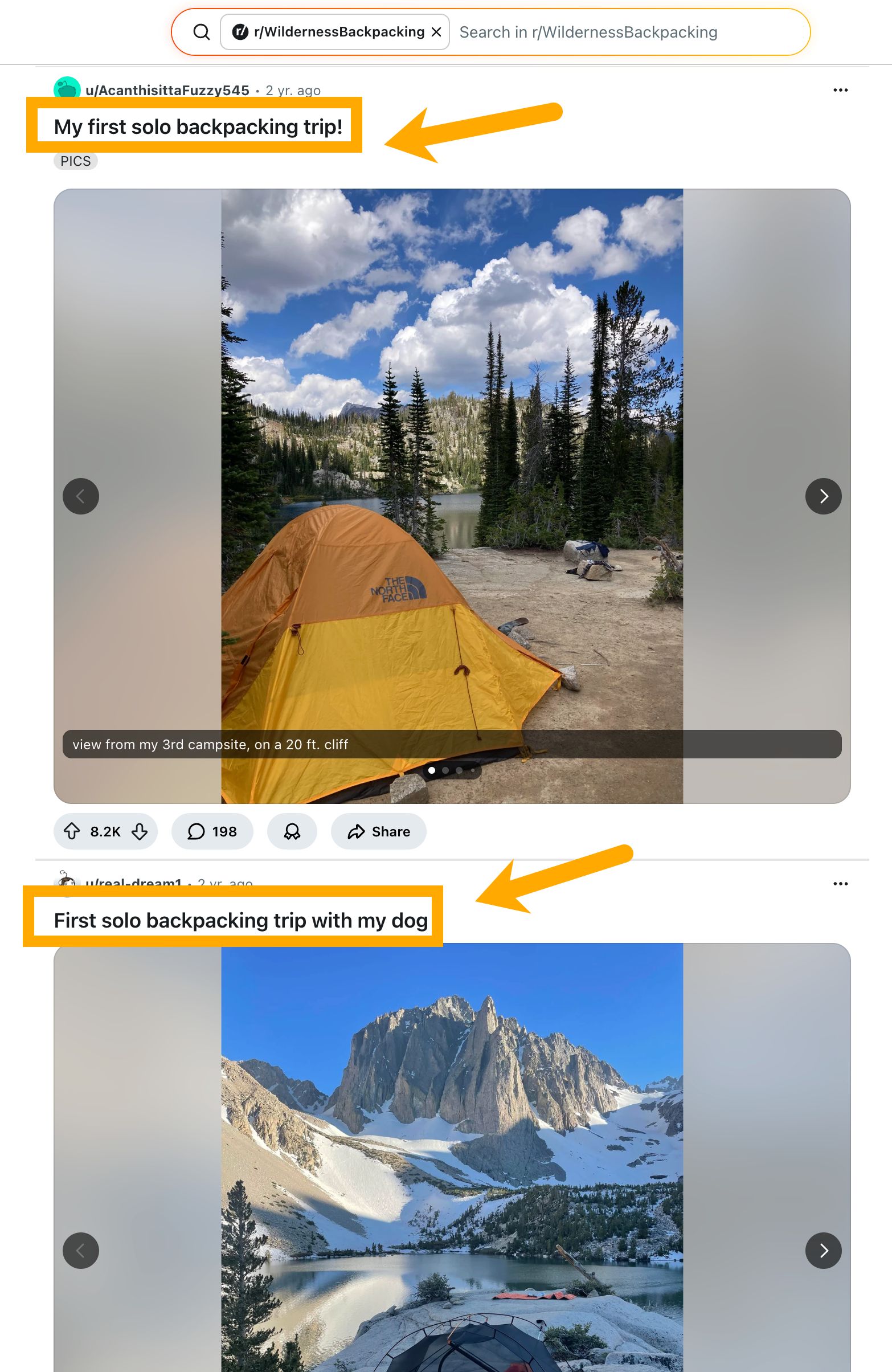
This is a popular, relevant keyword for anyone targeting hiking topics, and reading the comments reveals even more angles to consider: how to plan a solo backpacking trip, how to take a dog on a backpacking trip, solo backpacking trip safety, how to avoid bears on a solo backpacking trip…
Here’s my process:
- Search Reddit for your main topic keyword
- Find 2-3 relevant subreddits (check subscriber count and recent activity to confirm they’re active)
- Sort by “Top” posts—past year or all time
- Look for question posts, rant posts, and “how do I…” posts
- Note the exact phrasing people use
What you’re looking for:
- Question formats: “How do you…”, “What’s the best way to…”, “Am I doing this wrong…”
- Complaint posts: These reveal pain points you can address in your content
- “Finally figured out…” posts: These show which solutions actually resonate with people
But here’s the important caveat: not every popular Reddit discussion is a searchable keyword. Some topics are community-specific conversations that people don’t actually Google.
So validate your findings. Run your best questions and topics through Keywords Explorer to check if they actually have search volume. You want topics that appear in both places—popular on Reddit and searched on Google. That’s where you’ll find the real opportunities.
If you work for a well-known brand, Reddit is already talking about you—and those conversations show up in Google (and AI conversations).
People recommend your product in “best X” threads, complain about it in rant posts, and compare you to competitors in buying decision threads. These discussions rank for real keywords, and they shape how potential customers perceive you before they ever visit your site.
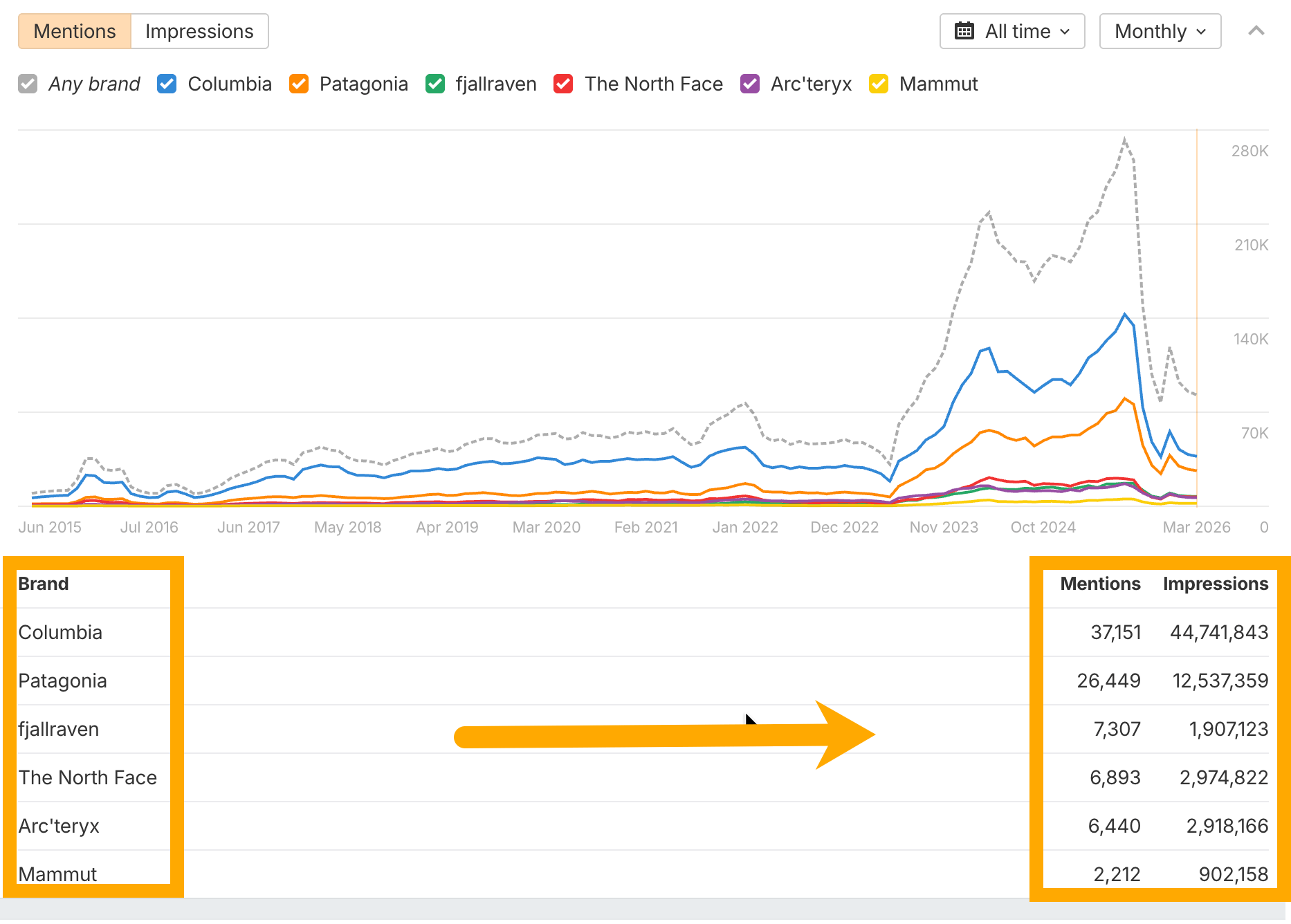
Ahrefs Brand Radar tracks Reddit threads, and you can search it for mentions of your brand and your competitors (and the estimated number of impressions those Reddit threads generate):
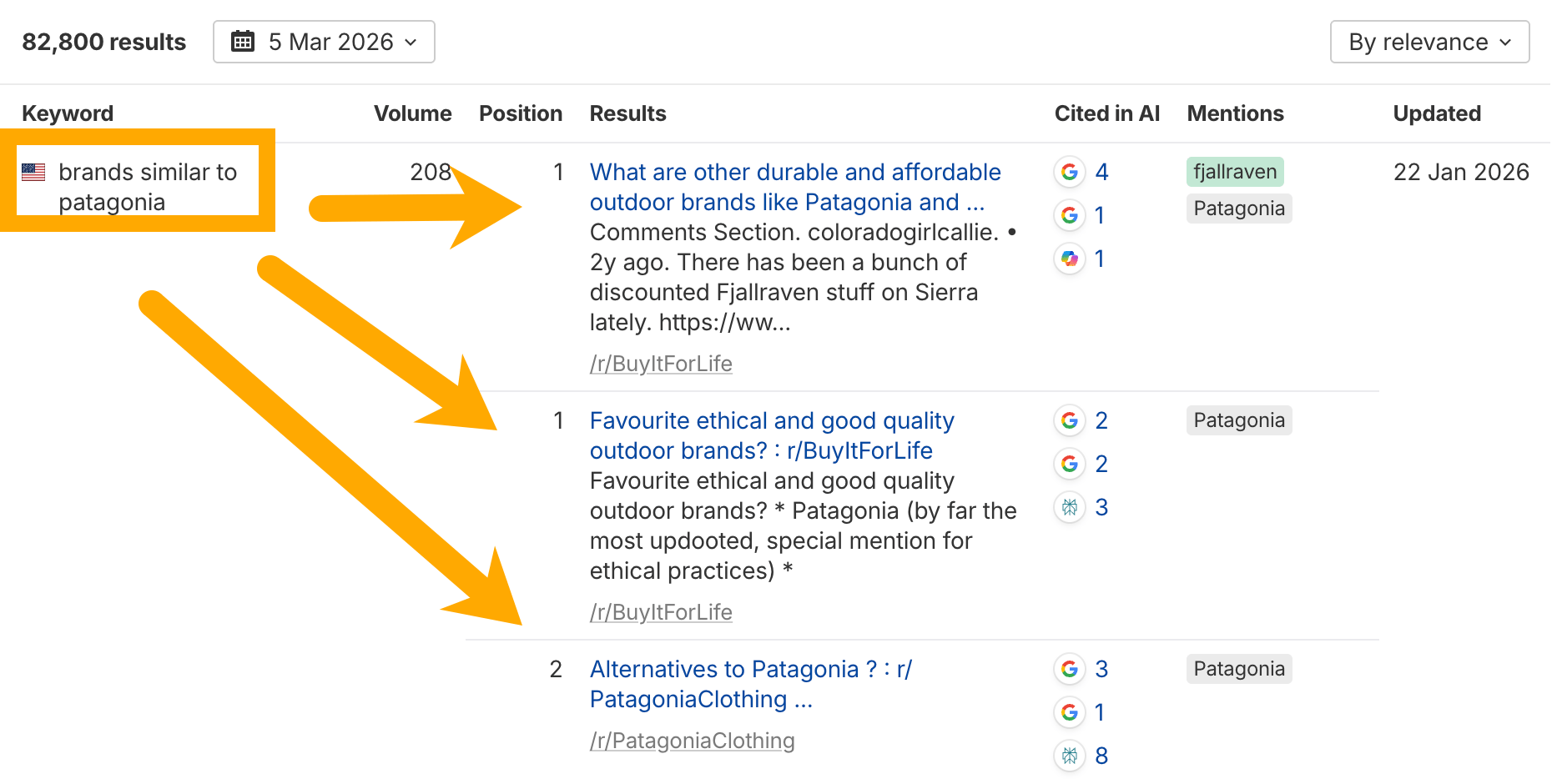
And see the specific Reddit threads where your brand (and your competitors) are mentioned:
This gives you a few things that are hard to get any other way:
- See how your brand is actually discussed. Not the messaging you put out—the language real users use when they talk about you. Are people recommending you for the right reasons? Are they bringing up problems you didn’t know about?
- Find gaps where competitors get mentioned but you don’t. If someone asks “what’s the best hiking backpack?” and every reply mentions Osprey, Gregory, and Deuter but not Fjällräven — that’s a visibility gap. And if that thread ranks in Google, it’s also a keyword gap
- See which keywords generate the most active Reddit discussions in your niche. Some keywords return dozens of threads with hundreds of comments. Others barely register. The keywords with the most Reddit activity tell you where your audience is most engaged—and where you could create content to capture attention that’s currently going to Reddit threads.
This is keyword research through a different lens. Instead of starting with search volume and working backward to intent, you’re starting with real conversations and working forward to keywords.
The topics people argue about, recommend products for, and ask for help with on Reddit are the topics worth targeting. Brand Radar lets you find them at scale, instead of browsing threads manually.
Reddit gives you raw keyword ideas. But you still need to validate them with actual search data and prioritize based on your ability to rank.
Here’s the workflow I use:
Step 1: Export and consolidate keywords from all 4 methods.
You’ll have a mix of keywords from Site Explorer exports, topics from Brand Radar, questions you noted manually, and opportunities from Google operator searches. Get them all in one spreadsheet.
Step 2: Run them through Keywords Explorer.
Paste your keyword list into Keywords Explorer to see:
- Search volume — Some Reddit topics are niche discussions, not searchable queries
- Keyword difficulty — Can you actually rank for this?
- Traffic potential — What’s the upside if you rank #1?
- Parent topic — This helps you identify clustering opportunities where one piece of content can target multiple keywords
Step 3: Prioritize strategically.
Focus on keywords where:
- Reddit ranks well but doesn’t dominate the top three spots (you’ll have a hard time ranking for those keywords)
- The topic has clear commercial or informational value for your site
- You have genuine expertise or a unique angle to add into your content
Step 4: Use Reddit discussions as content research.
Don’t just find keywords—use the threads to understand what to cover. The discussions tell you exactly what people want to know, which objections they have, and which solutions work.
Final thoughts
Reddit is valuable for keyword research because it shows you real conversations. The exact questions people ask, the language they use, the problems they’re trying to solve.
There’s a lot you can find out with simple Google searches, but the real benefit comes from combining manual exploration with real search data. Keywords Explorer validates that your Reddit-sourced ideas actually have search demand. Site Explorer turns entire subreddits into keyword databases. Brand Radar lets you see exactly where and how your brand is being discussed on Reddit.
So here’s what I’d do next: pick one subreddit relevant to your niche. Plug it into Site Explorer, sort by traffic, and look for keywords where Reddit ranks in the top 10. Find one where you could create something more helpful than a scattered discussion thread. That’s your next content opportunity.
Got questions? Let me know on LinkedIn.