

Wikipedia plays a cornerstone role in influencing online visibility. But what about Grokipedia, the new AI-generated wiki on the block?
Is Grokipedia a serious competitor to Wikipedia, or just a doomed exercise in billionaire hubris? Does Grok bring new value to the table, or just rehash the same old content? Does Grokipedia influence AI search in a similar way to Wikipedia?
To find out, we used data from Ahrefs Site Explorer and Brand Radar to compare crucial metrics: page count, traffic, AI citations, page length, semantic similarity, and much more.
Competitor analysis on any domain
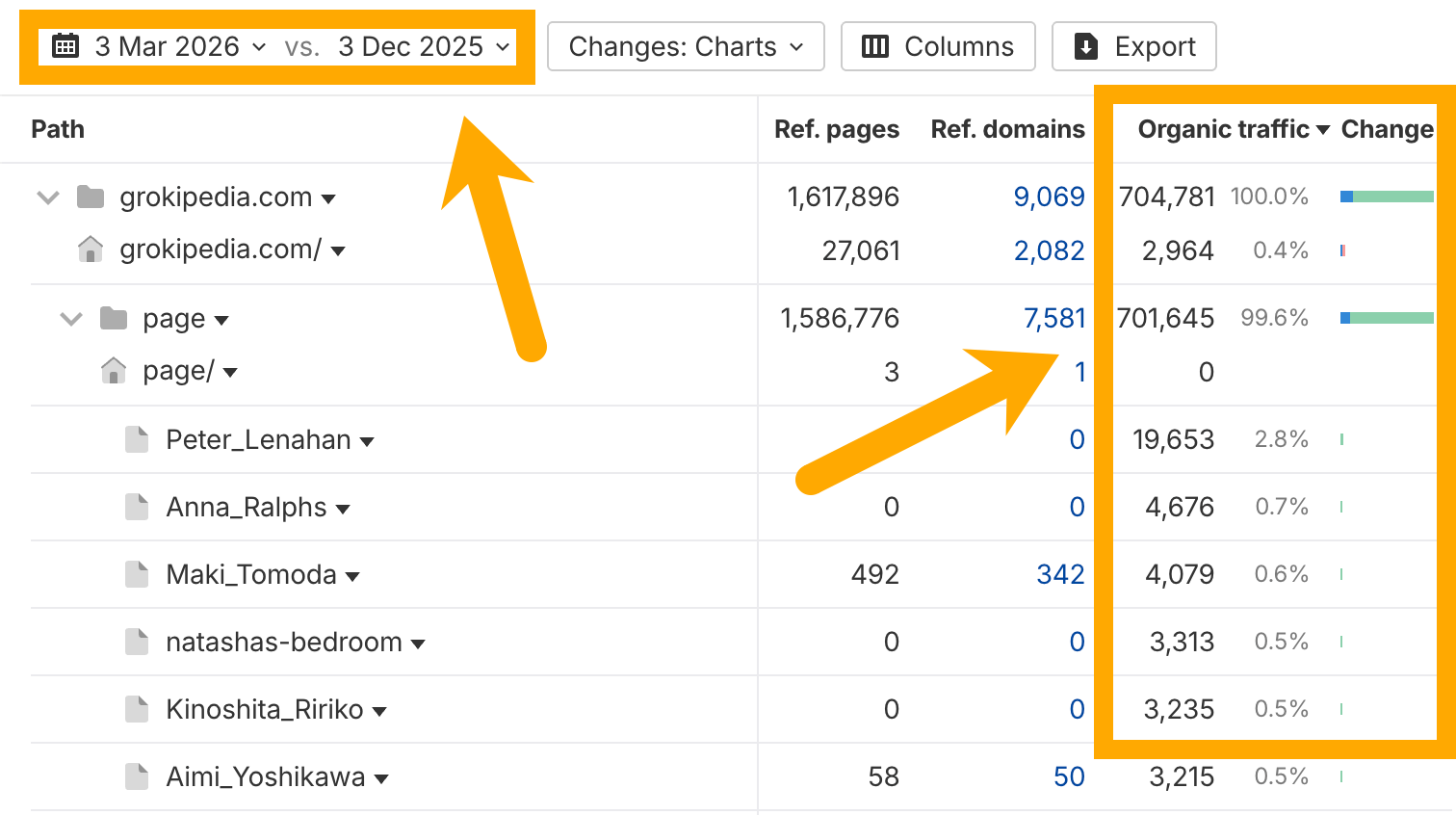
Use Site Explorer to analyze key performance metrics for virtually any domain: pages, estimated organic traffic, links and referring domains, AI content usage, and much more.
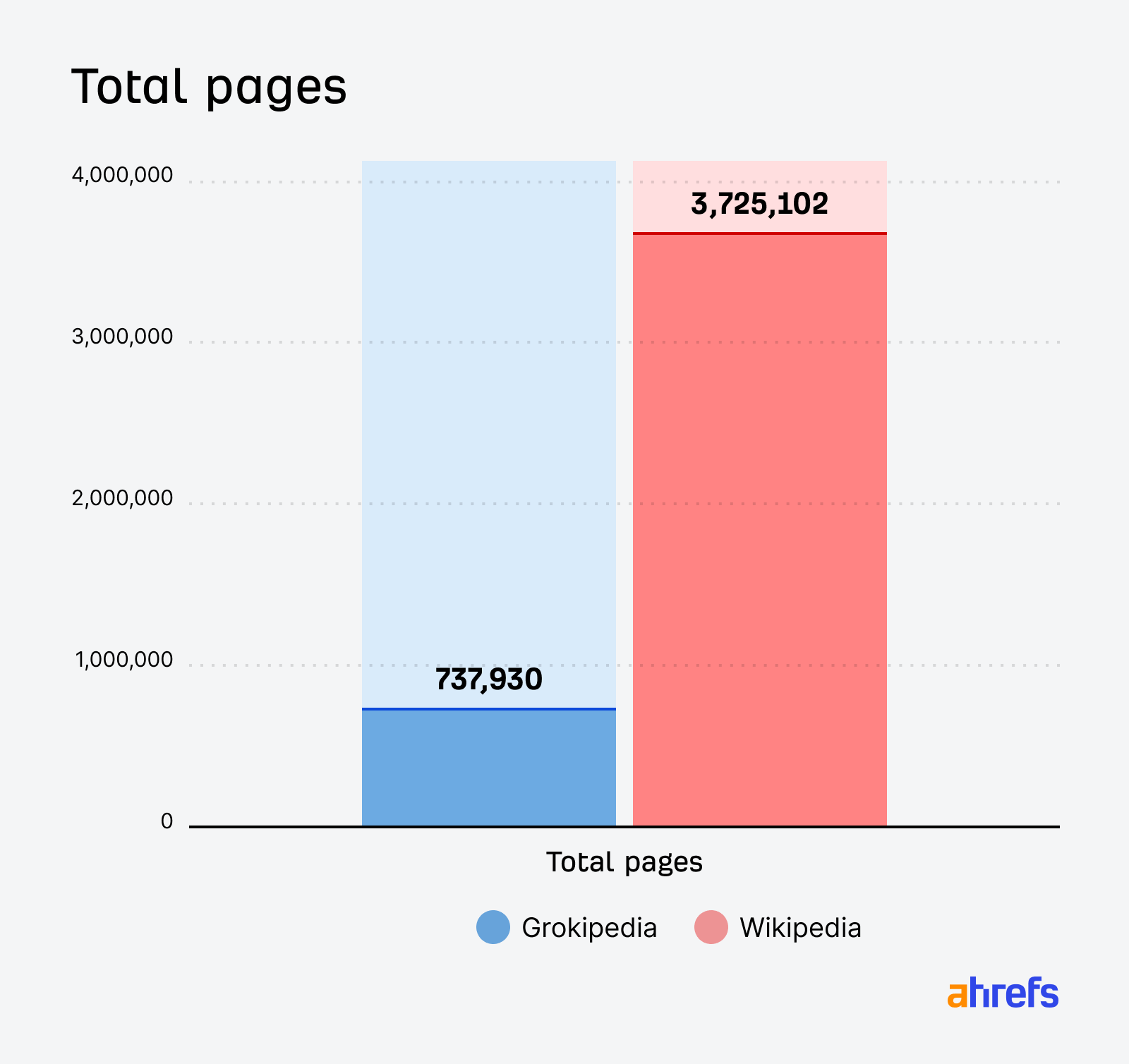
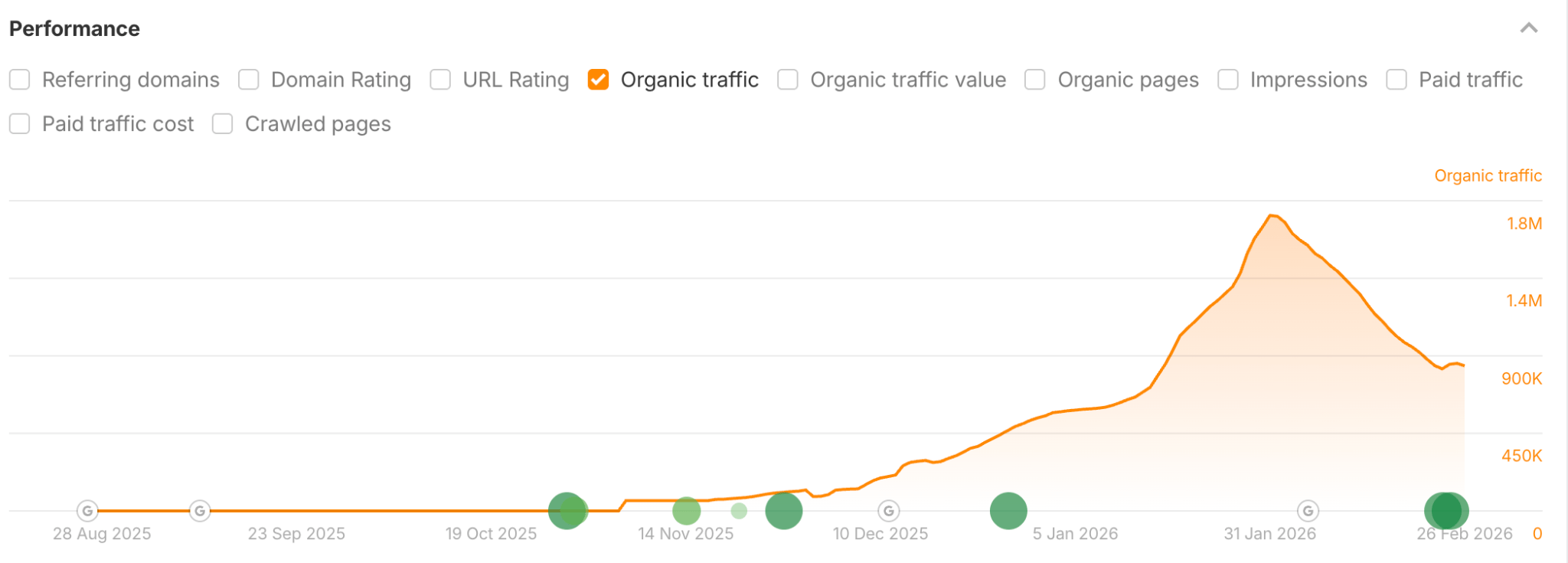
Since release in October 2025, Grok has churned out a staggering amount of content: 737,930 published pages.
By comparison, Wikipedia has 3,725,102 crawled pages, or five times greater. Given how quickly Grok is amassing content, it seems plausible that the site could overtake Wikipedia’s total page count.
Assuming Wikipedia’s page count stays static and Grokipedia publishes new pages at the same rate (almost 6,000 pages per day since launch), Grokipedia would overtake Wikipedia in roughly 500 days, or circa July 2027.
But although it’s easy for AI to pump out masses of pages, it’s not so easy to earn organic traffic.
We estimate Wikipedia’s organic traffic at ~2,100,000,000 pageviews per month, compared to ~1,300,000 for Grok: a difference of 1,615x (requiring a log scale to plot on the same chart):
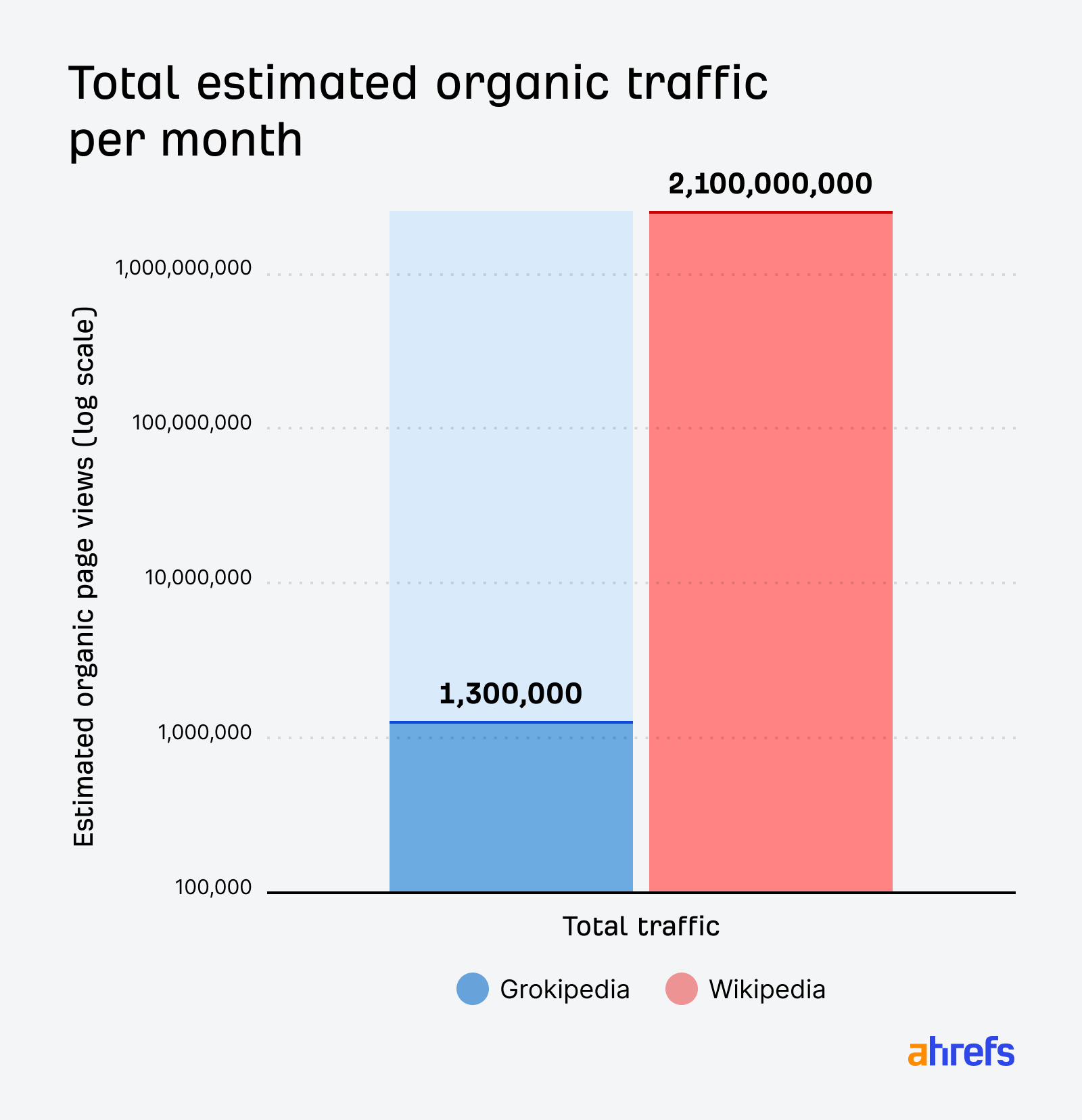
Put another way, for every single pageview a Grokipedia page receives, Wikipedia receives 1,615.
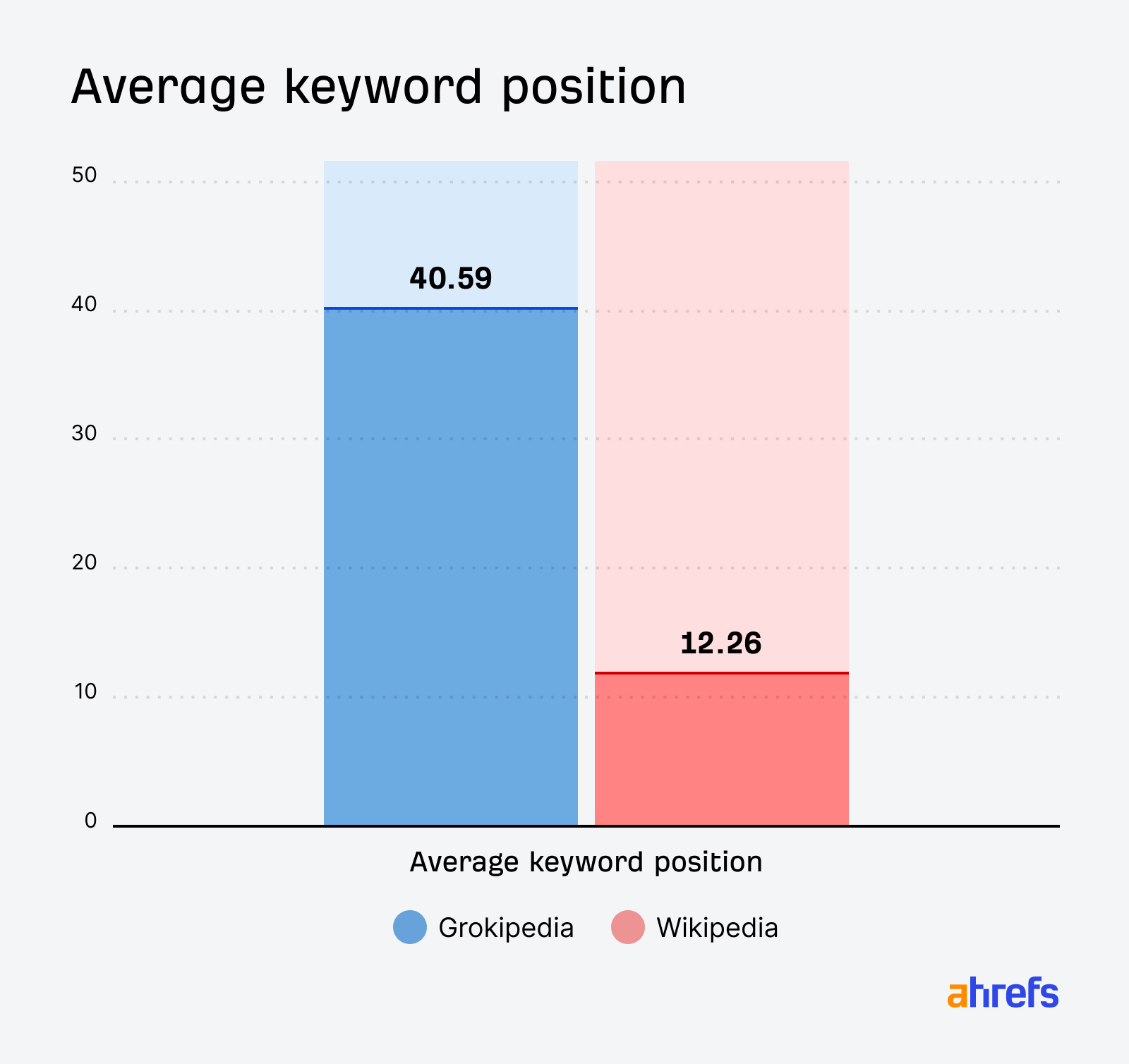
This traffic difference is explained partly by keyword rankings. Grokipedia ranks for 1,193,013 keywords with an average keyword position of 40.59. Wikipedia ranks for 45,573,106 keywords, or 38x more, with an average position of 12.26:
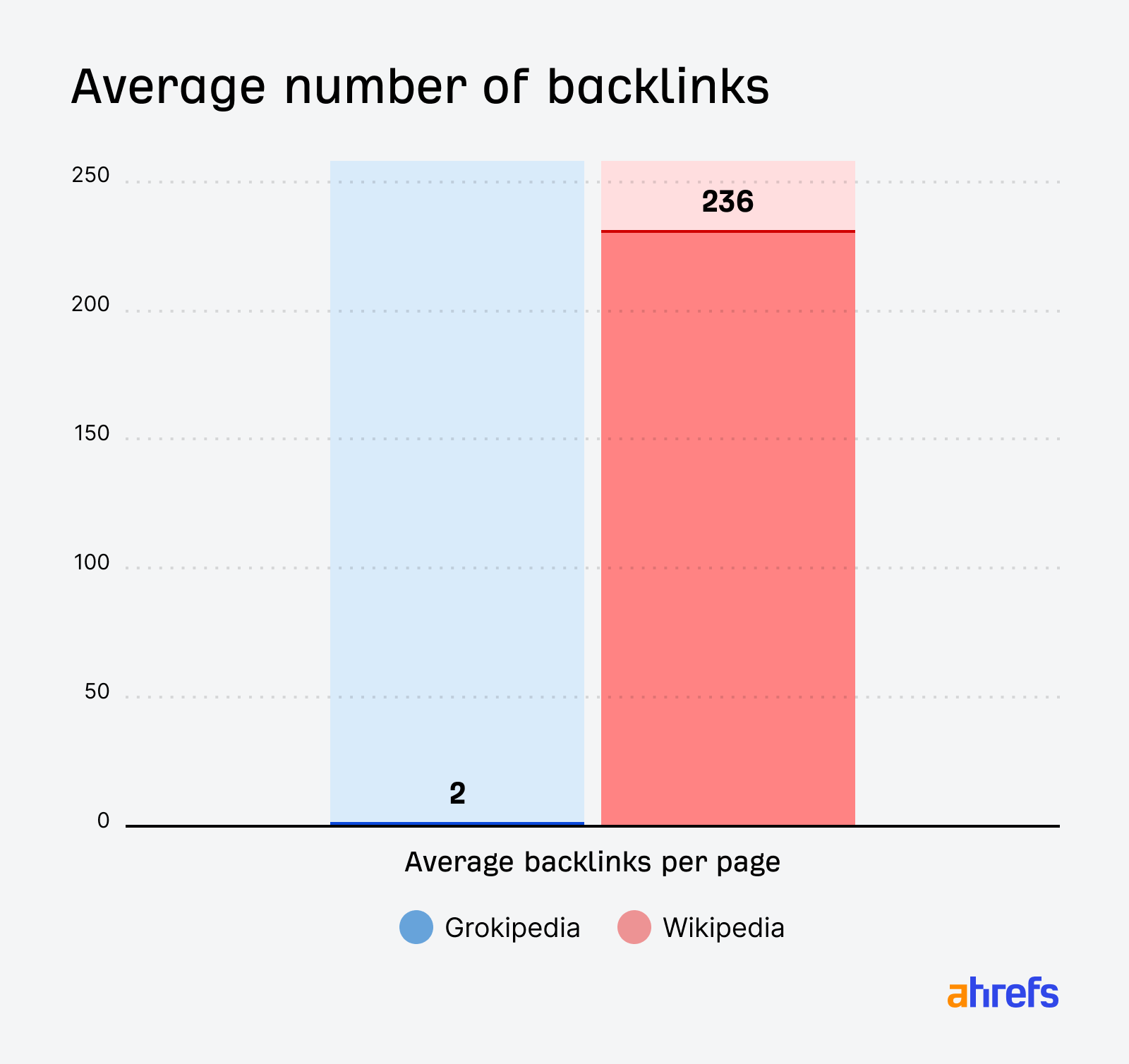
Wikipedia has 879,615,708 backlinks to Grokipedia’s (still very impressive) 1,414,654 backlinks, or 622x more. Dividing backlinks by total page count, Wikipedia has ~236 backlinks per page to Grokipedia’s ~2:
It’s a similar story for referring domains: 2,024,916 for Wikipedia and 8,016 for Grokipedia, or 253x more. Wikipedia has 0.54 referring domains per page to Grokipedia’s 0.01.
By all traditional search metrics—bar one, number of pages—Grokipedia has a staggering amount of catch-up to do.
We randomly selected 100,000 Grokipedia-Wikipedia article pairs (two articles covering the same topic) to compare content structure for both wikis.
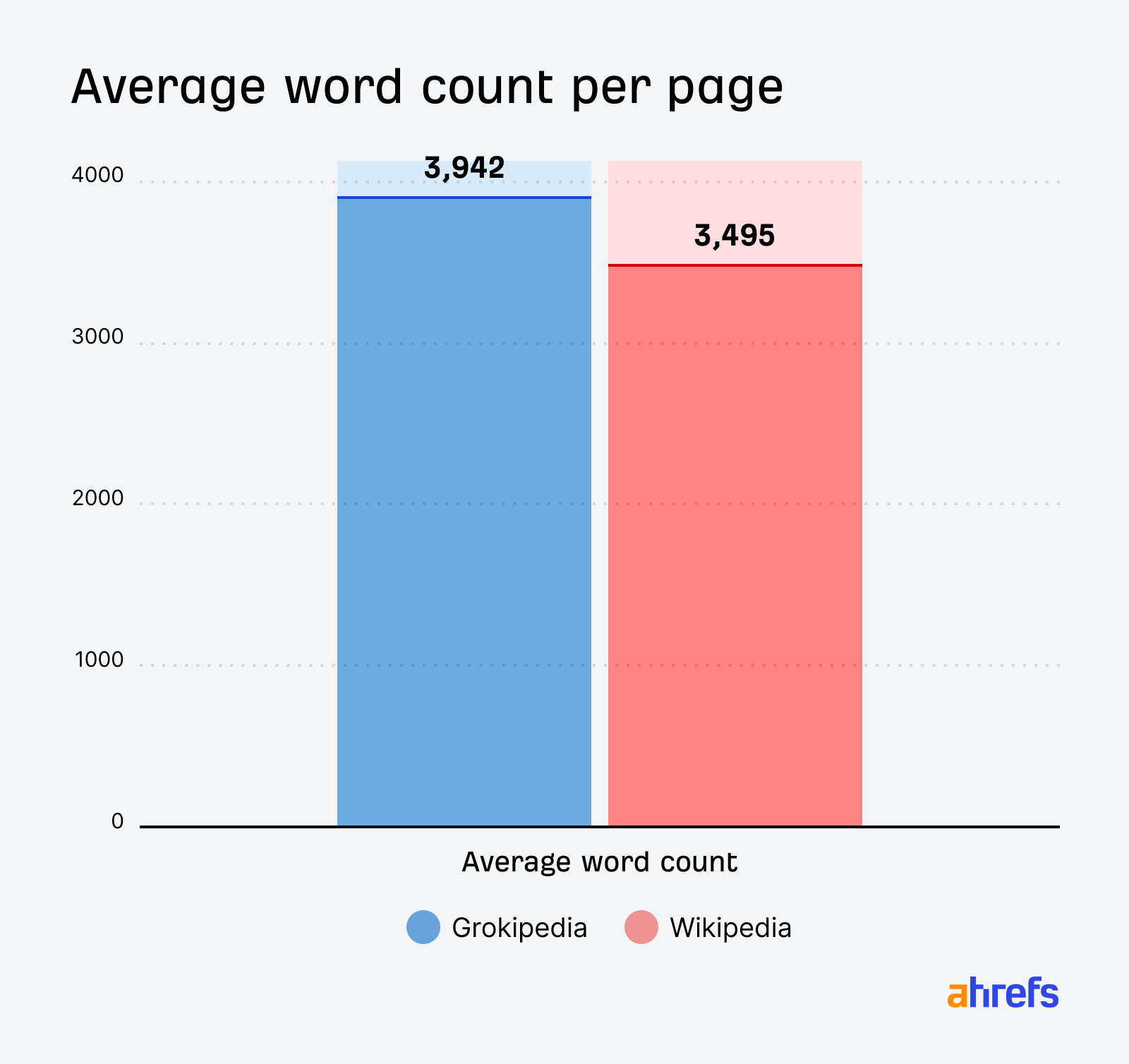
Grokipedia pages average 3,942 words compared with Wikipedia at 3,495, a difference of around 13%—slightly longer, but less of a difference than I expectedm given how “cheap” generative AI has made content creation:
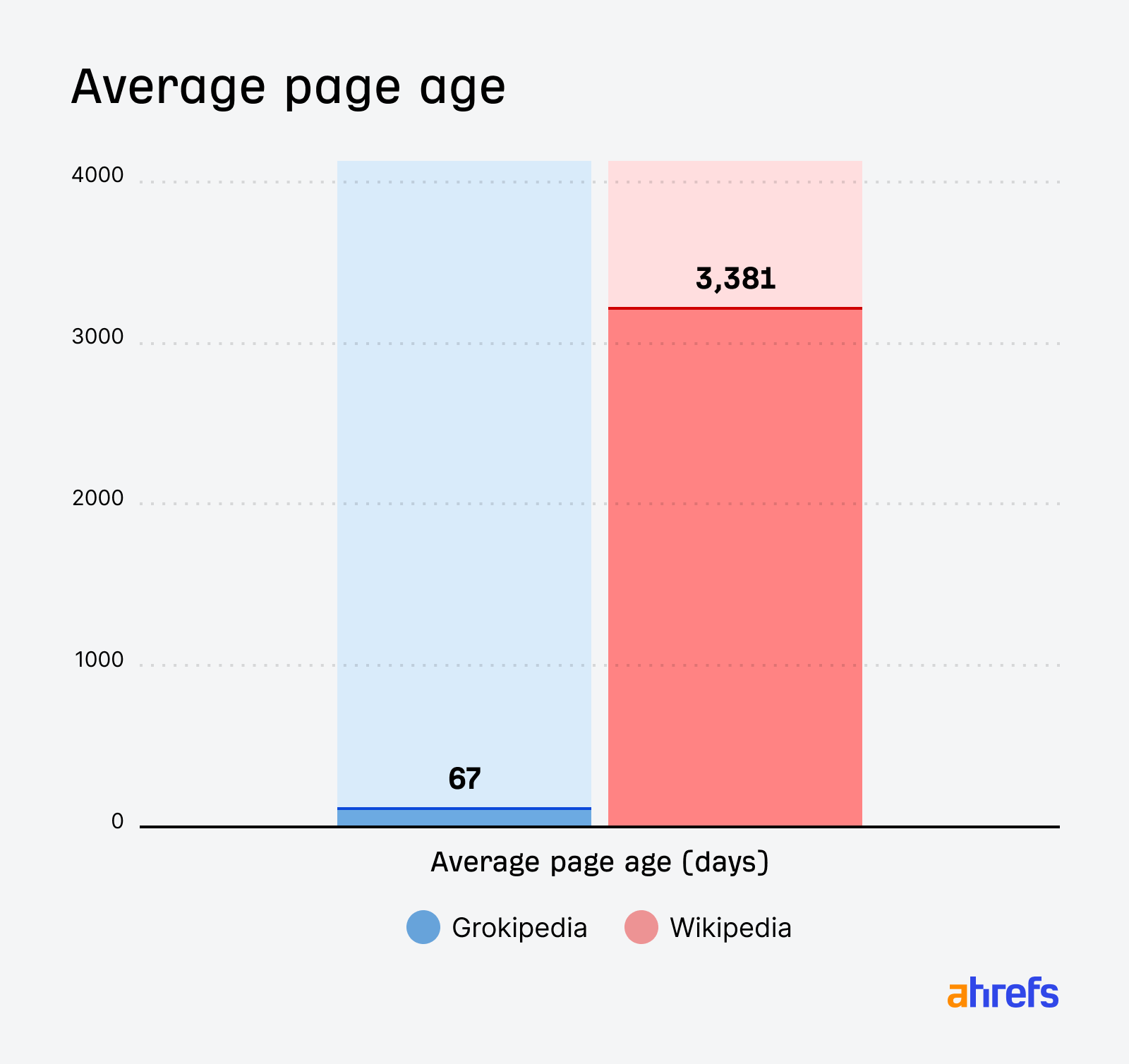
Grokipedia launched in October 2025, so the average age of its pages (as measured by the average time since our crawler first detected the URL) is only 67 days. Wikipedia, by comparison, has an average page age of 3,381 days—9.3 years, or almost 51x older:
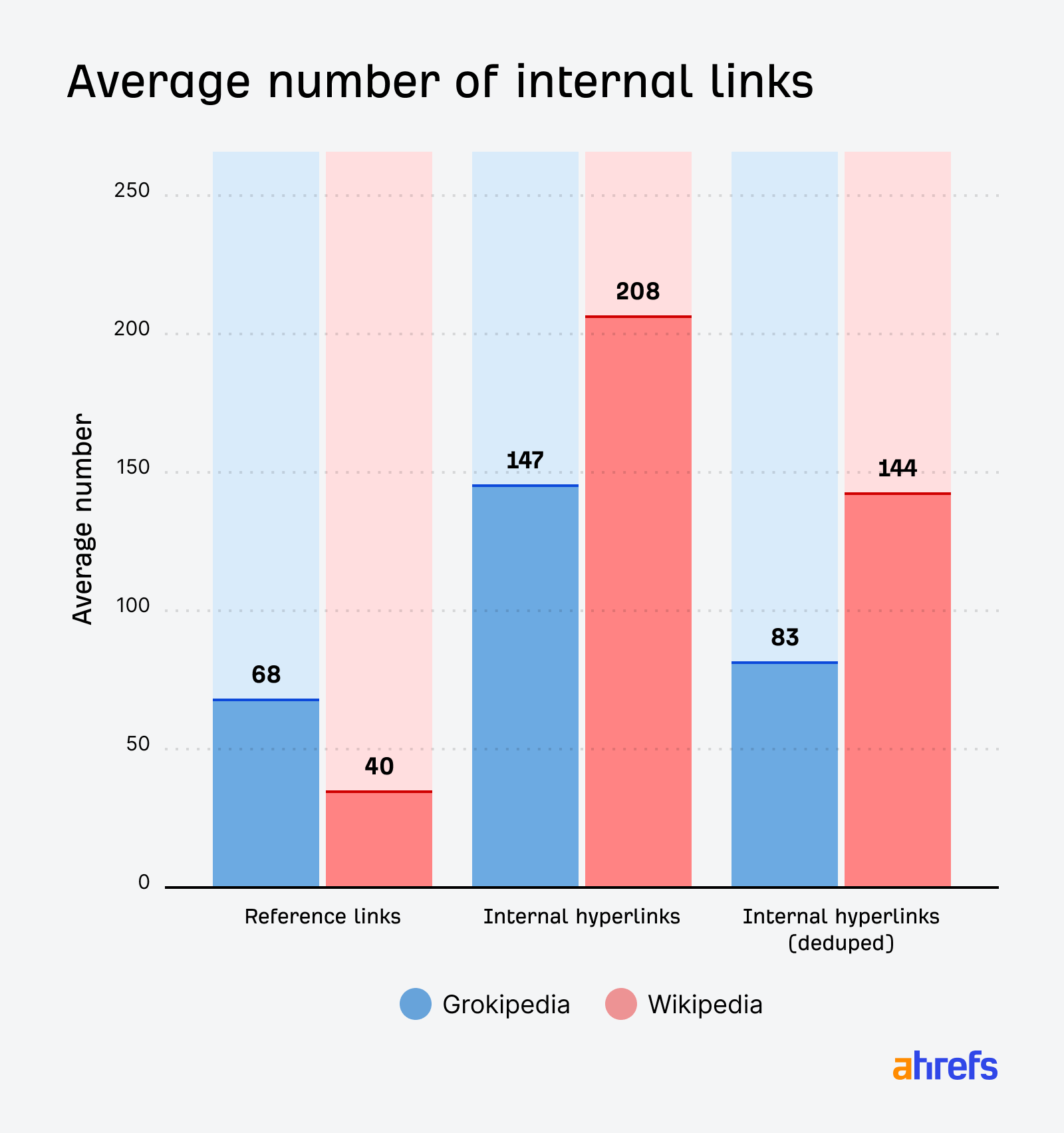
Surprisingly, Grokipedia has more external links in its reference section: an average of 68 per page, compared with Wikipedia’s 40.
But Wikipedia, with over five times as many total pages, is much better at internal linking between related concepts, with an average of 144 unique internal links per page to Grokipedia’s 83:
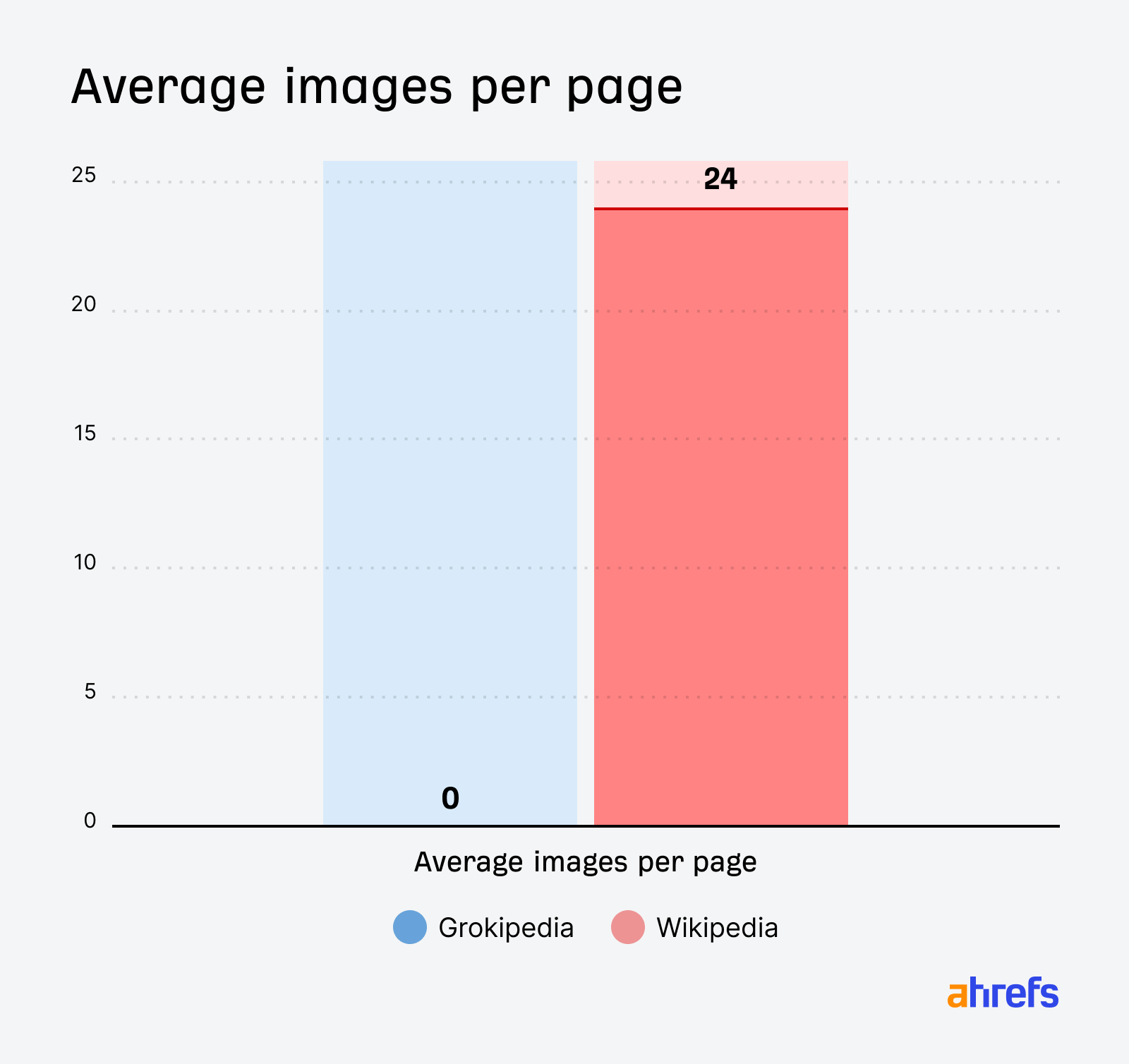
Images show the starkest difference. Wikipedia’s human-written, human-edited content contains an average of 24 images per page. Grokipedia has an average of… zero images per page:
Grokipedia is relatively good at earning AI citations.
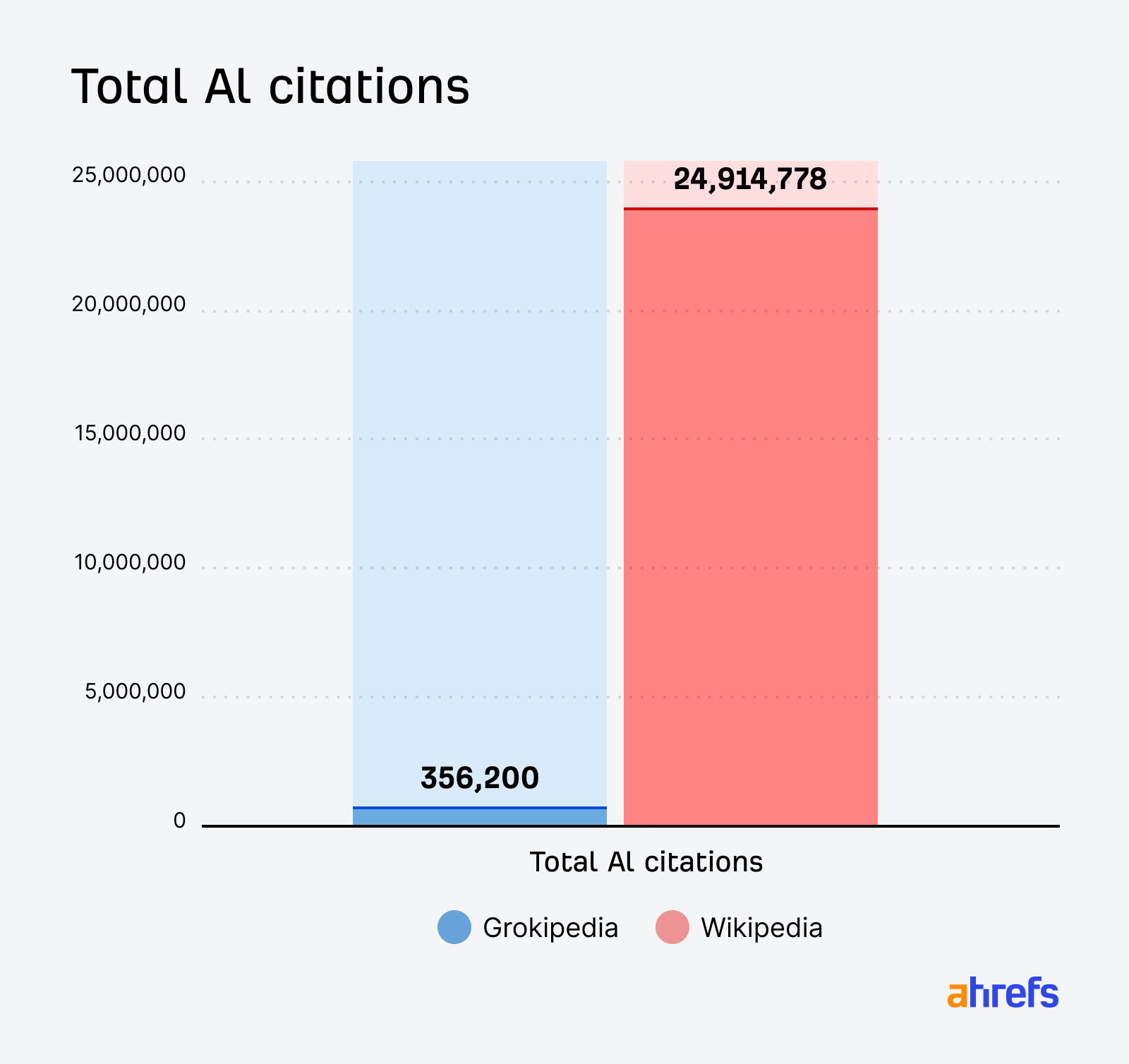
Despite having have 1,615x the total traffic of Grokipedia, Wikipedia has “just” 70x the number of AI citations: 356,200 for Grokipedia versus 24,914,778, or an average of 0.48 citations per page for Grokipedia, and 6.69 for Wikipedia:
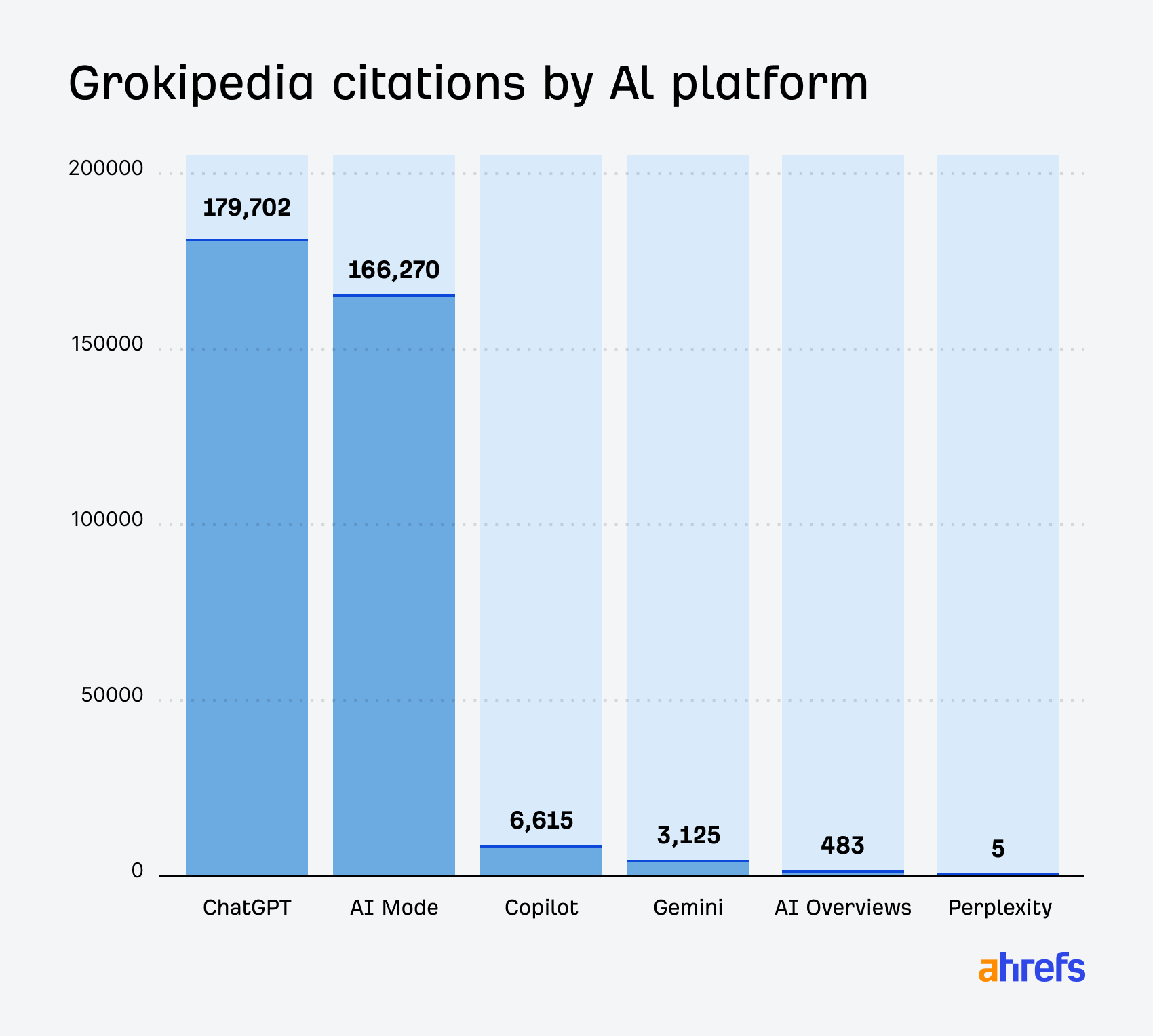
Grokipedia has earned the most citations from ChatGPT and Google’s AI Mode, with Copilot and Gemini a distant third and fourth:
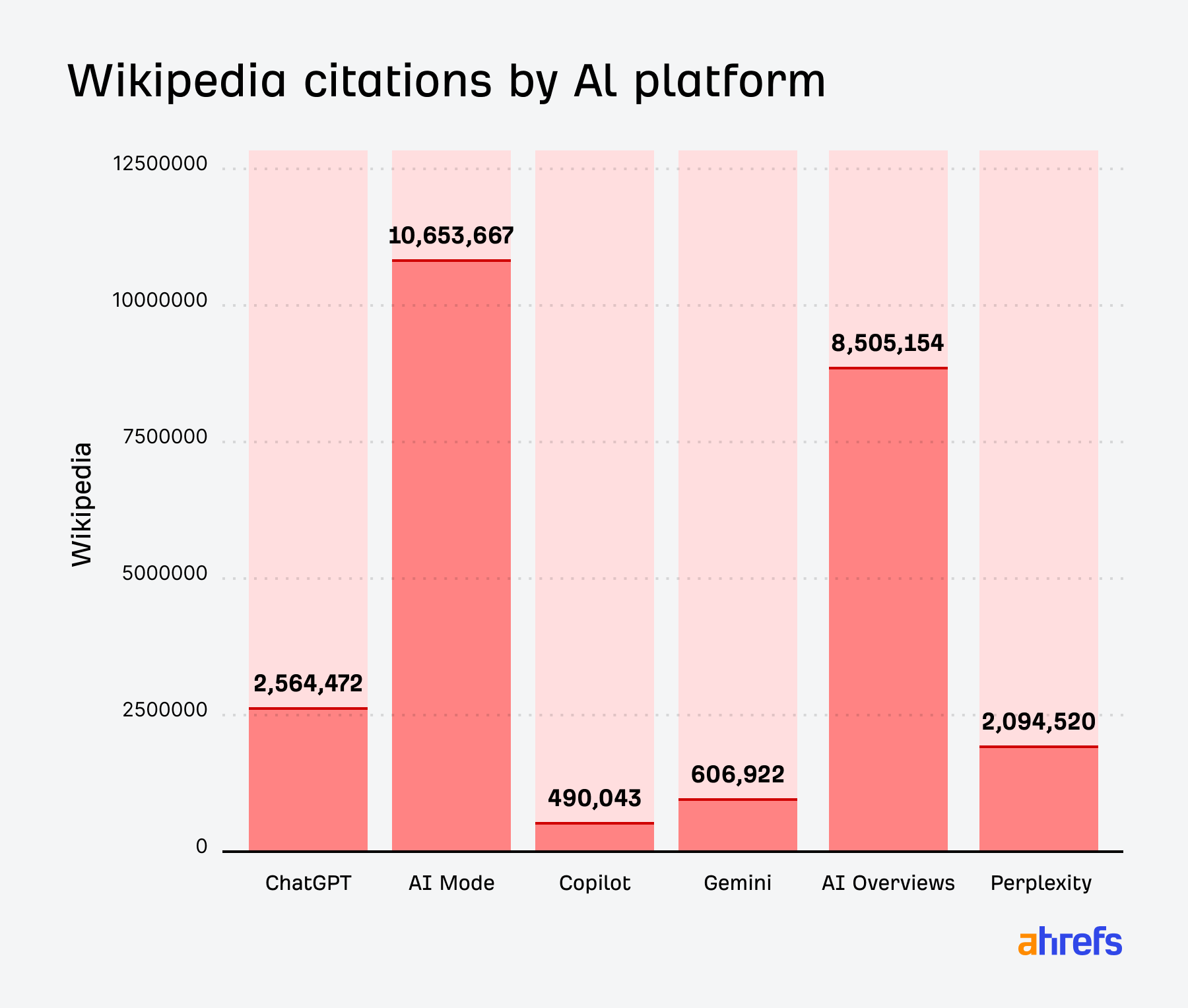
By comparison, the bulk of Wikipedia’s citations come from AI Mode and AI Overviews, with ChatGPT and Perplexity in third and fourth:
We can also look at the relative distribution of citations across different AI platforms by comparing both wikis on the same chart (with different axes… please excuse my graph crime).
Most notable is the difference in citations from AI Overviews and ChatGPT:
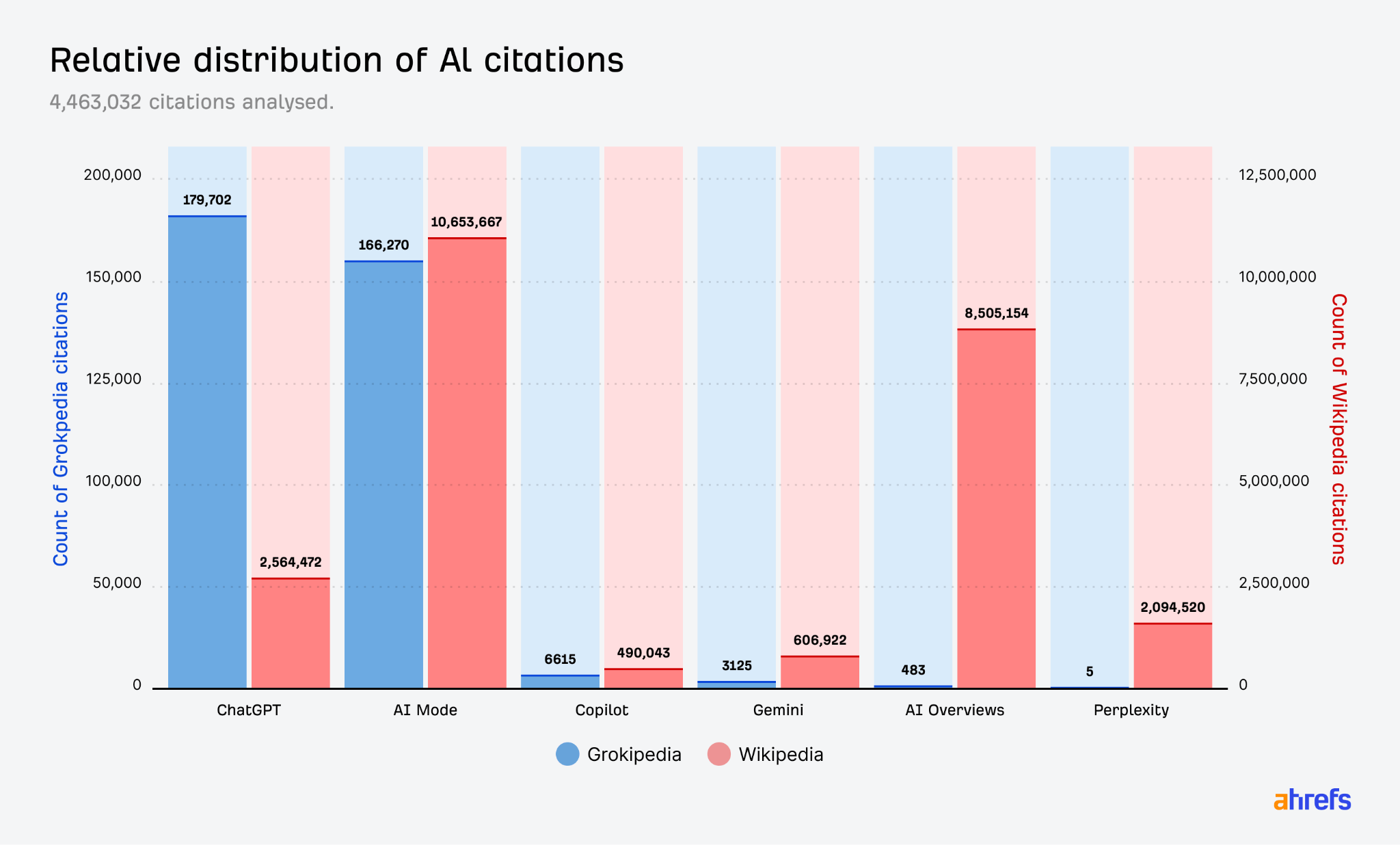
Considering that citations in AI Overviews are anchored heavily in the existing search results, it’s perhaps no surprise that Grokipedia—with a much lower average ranking position than Wikipedia—struggles to get cited in AIOs.
By contrast, ChatGPT seems to have a relative bias against citing Wikipedia, but no such issue with Grokipedia.
Measure AI visibility for any domain
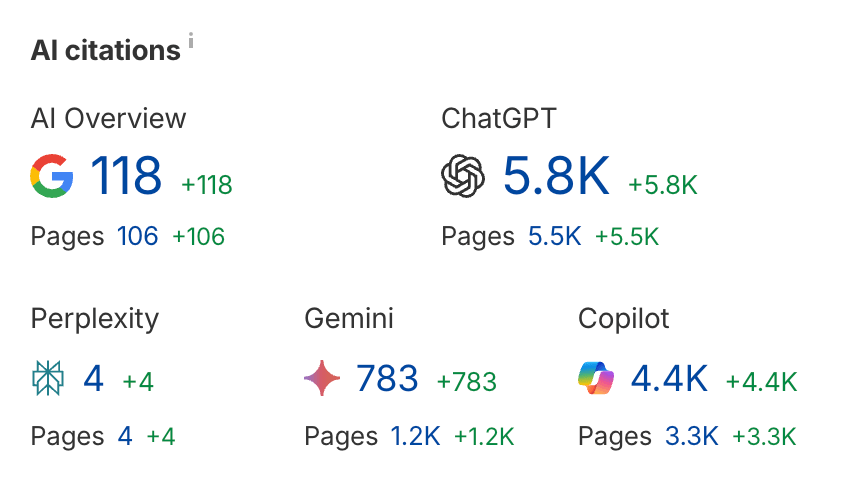
Ahrefs Brand Radar lets you search, filter, and export our massive database of millions of AI prompts and outputs, across AI Overviews, AI Mode, ChatGPT, Perplexity, Gemini, and Copilot. Discover how virtually any domain shows up in AI search:
Given that Wikipedia is a crucial source of training data for most LLMs, and Grokipedia is written entirely by generative AI, I wanted to know: how similar are Grokipedia and Wikipedia pages?
To find out, we compared 10,000 “topic pairs”: pairs of Wikipedia and Grokipedia pages covering the same topic and referring to the same entity.
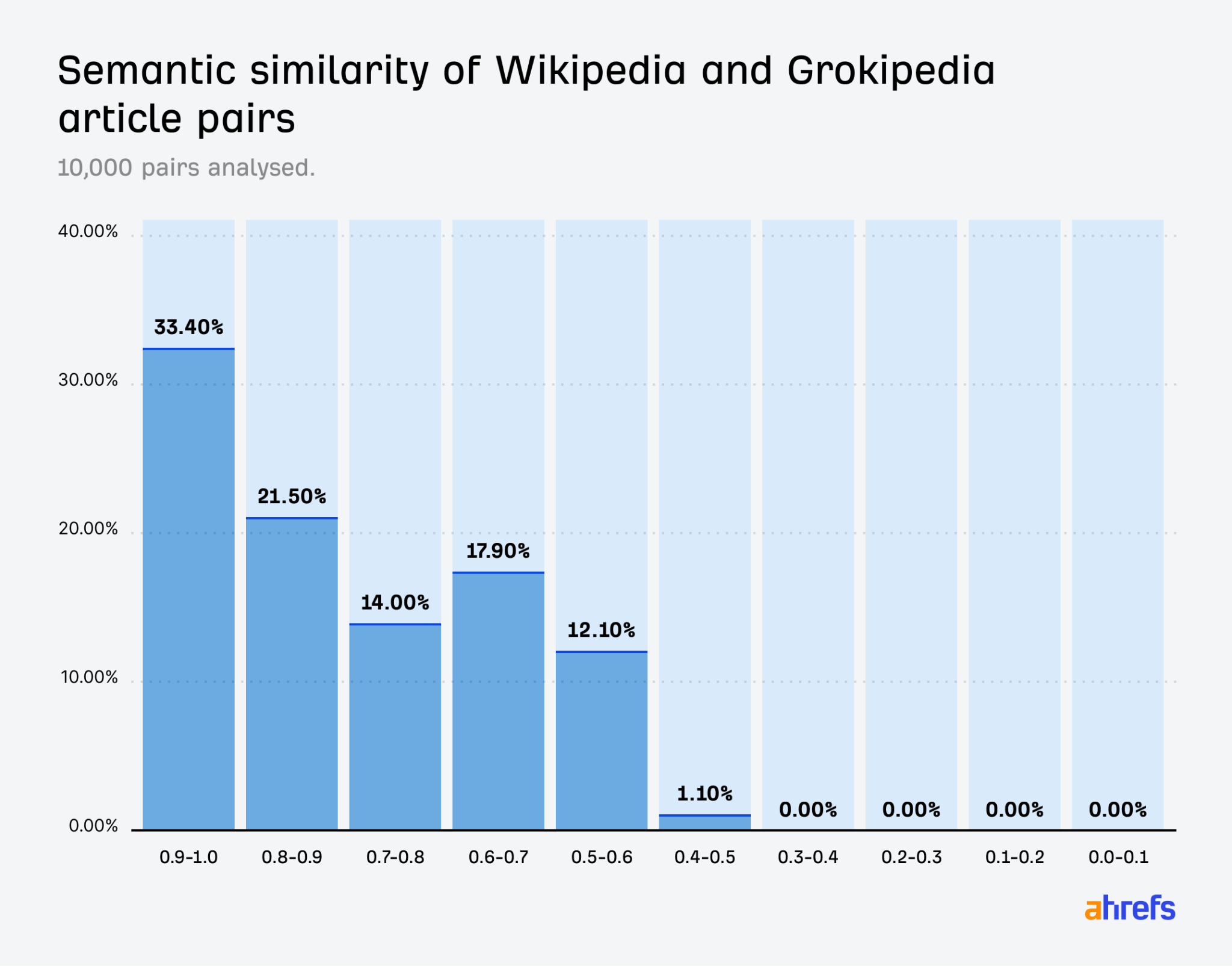
The mean semantic similarity of these topic pairs was 0.791, and the median was 0.831:
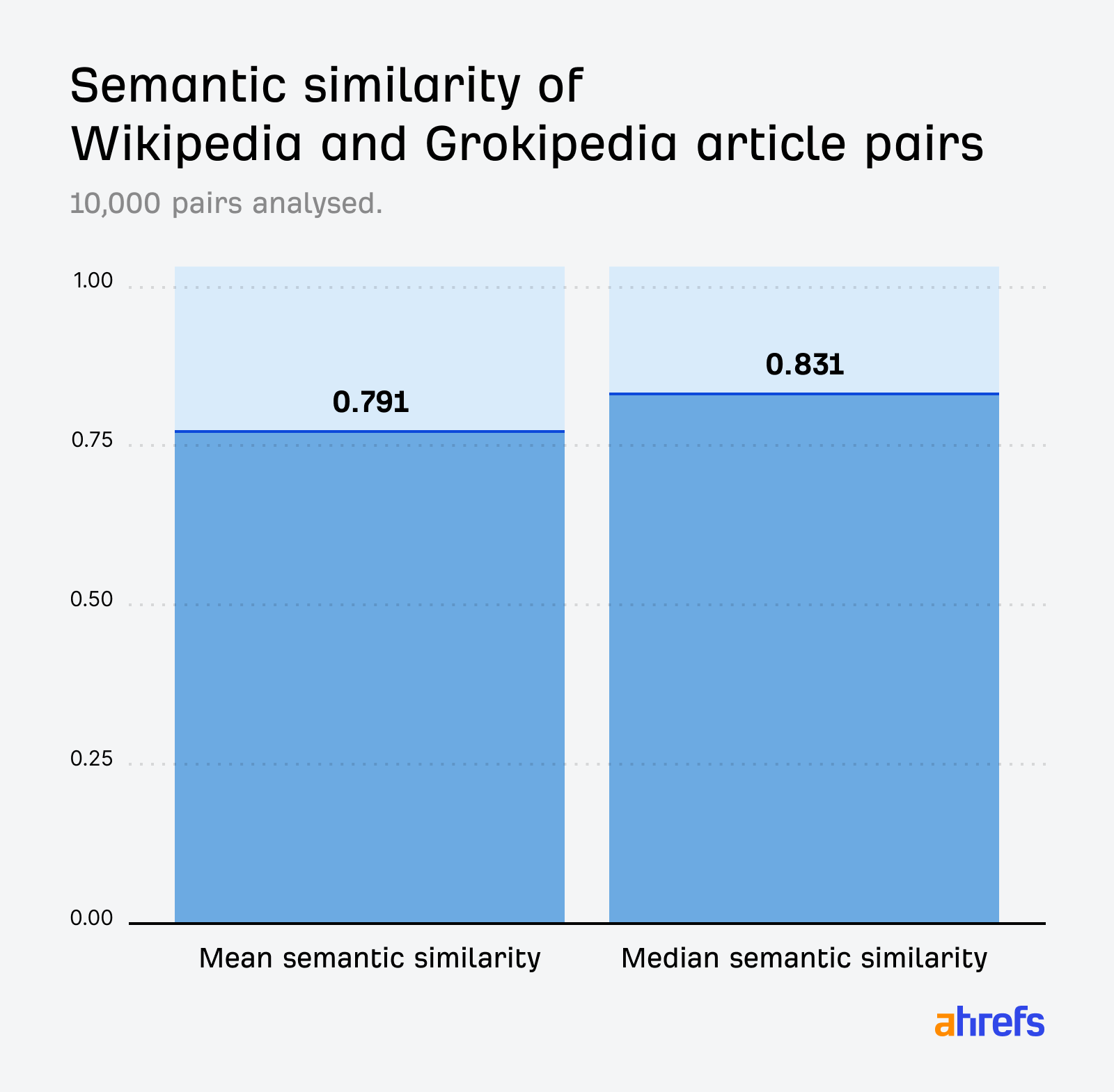
This is very strong semantic overlap. For context, if we take Grokipedia pages and compute their cosine similarity with random Wikipedia pages (that is, mismatched pairs), the mean cosine similarity is ~0.62.
Similarly, if we take other pages that rank for the same keywords as Grokipedia and Wikipedia pages, the average cosine similarity is ~0.61:
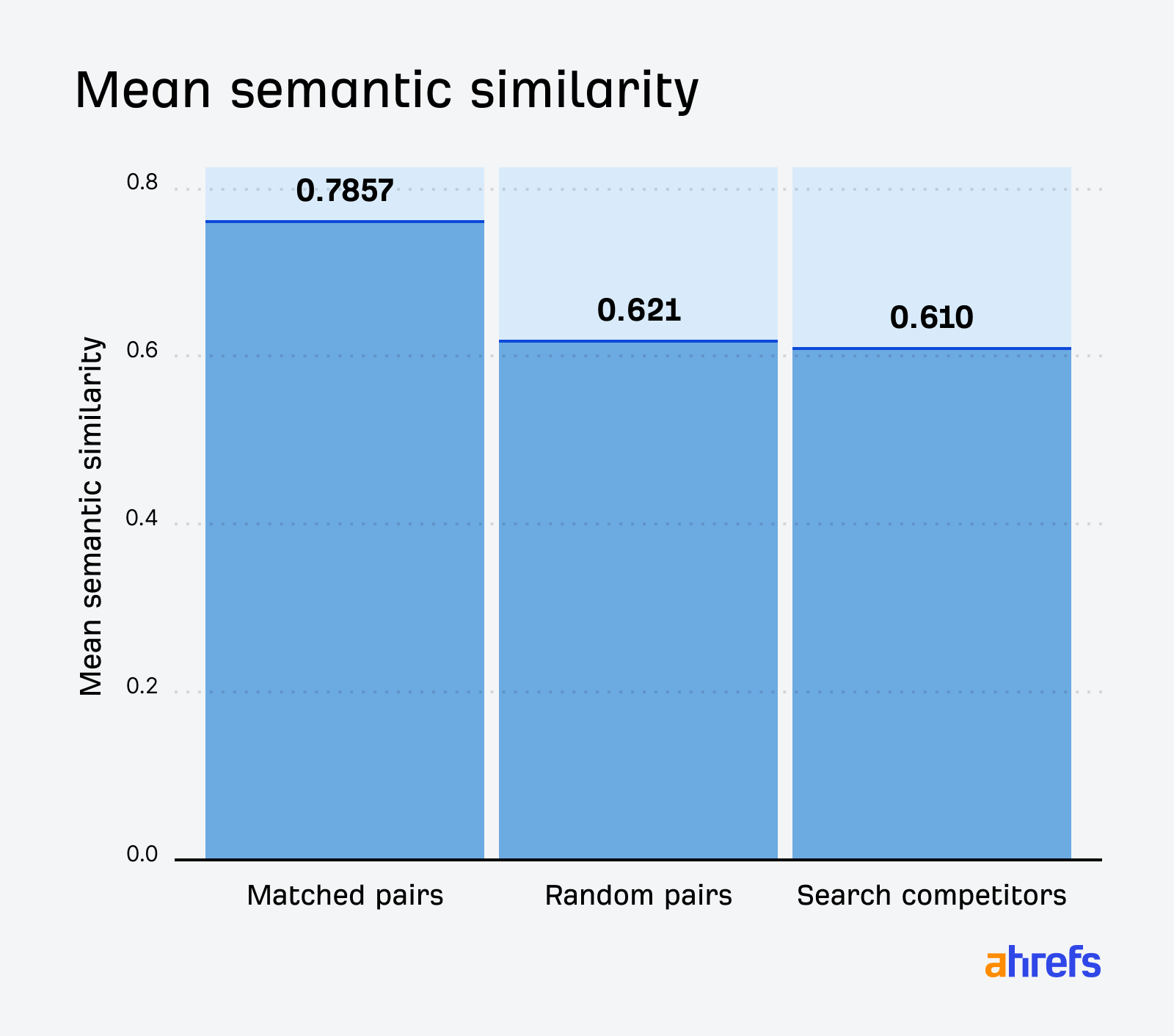
83% of the topic pairs we analysed had a cosine similarity greater than 0.62, indicating that Grokipedia pages share a very strong semantic overlap with Wikipedia pages describing the same entity:
Final thoughts
Grokipedia seems to represent a new model for wikis: AI-generated content designed for AI consumption.
Grokipedia has a relatively strong influence on AI citations, relative to its size, but a relatively weak influence on real people (as measured by estimated pageviews). Grokipedia pages are very similar to Wikipedia pages on the same topic, and it’s hard to avoid the image of the ouroboros eating its own tail. Certainly, the reading experience seems more intended for AI consumption than human.
If you’ve got other ideas for Grokipedia analysis, let me know on LinkedIn.