

The truth is far less dramatic.
Keywords aren’t dead, but optimising for them one at a time is like trying to light up a galaxy one star at a time. The real shift is a change in scale and mindset: from thinking about individual queries to the whole conceptual space around them.
Here’s what that shift actually looks like and how to help search engines associate your brand with a whole subject area, not just a handful of queries.
A keyword is the exact word or phrase someone types (or speaks) into a search platform. It’s explicit, measurable, and tied to a single query, like “best running shoes for flat feet.” A topic is the broader concept that a keyword belongs to, the cluster of meaning, intent, and related ideas that surround it, like “running footwear”.
Think of it this way: a keyword is like a single star in space. A topic is the galaxy it belongs to.

Source: Science News
This isn’t just a casual analogy. Modern search engines and AI systems actually map meaning so that related concepts end up close together, while distant ones are far apart.
They operate on “semantic spaces”. That is, spaces where they can discover meaning in how things relate to each other.
Keywords exist in that space as a core data set used by search systems (traditional and AI). But they’re not alone. They’re also mapped alongside documents (like your webpages), multimedia content, and more.
The technical term for all these objects within semantic search spaces is “vector embeddings”.
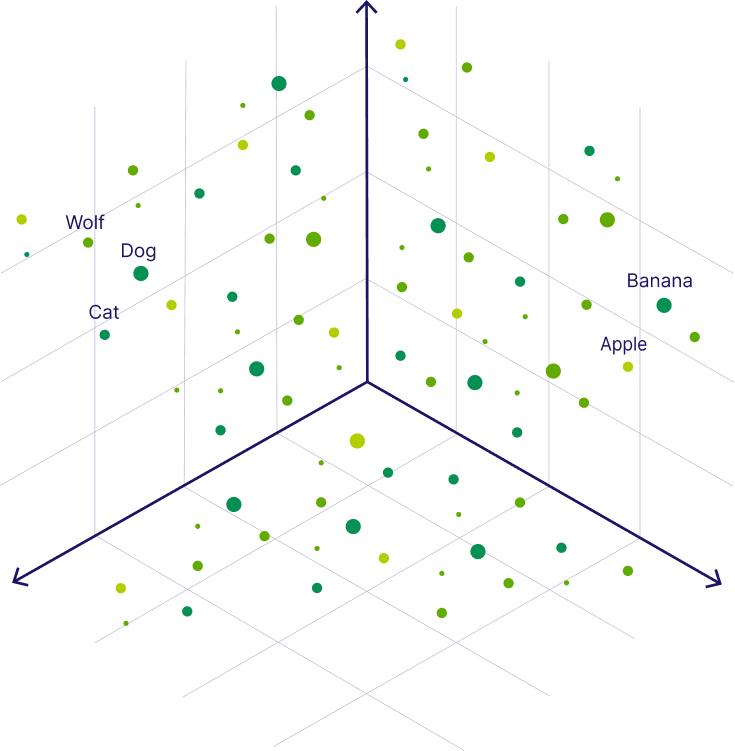
Source: weaviate.io
Brands exist in that same space, and search engines can strengthen their association with topics through knowledge graphs (databases of real-world entities, including brands, people, places, and concepts, along with the relationships between them).
These associations influence which brands surface across a whole topic area, not just for the specific queries they target.
Not all topics are created equal. The size and complexity of a topic determine what it actually takes to optimize for it.
Traditional keyword research and topic mapping handle this by adding individual keywords to a list one at a time and then clustering them to form a content plan.
This works well at small scales but becomes unwieldy, and eventually impossible, as your topic grows. The three-tier approach below is the next step: a more systematic way to think about topic territory, so your keyword research scales with your ambitions.
Some topics have clean, natural boundaries. The number of relevant keywords is small, the intent is consistent, and it’s entirely possible for one brand to cover it completely.
Using our space analogy, we’re looking at maybe a handful of planets and their moons. Yep, in the vastness of the universe, we only care about this super tiny corner of space.
A small number of objects connect to each other, forming the topic. The whole system is contained, easy to map, and relatively straightforward to own.
Where many go wrong is expanding into adjacent topics that don’t add much business value and dilute their topical focus.
For example, a worm farmer who specializes in red wigglers only needs to care about 1,070 keywords (maximum):
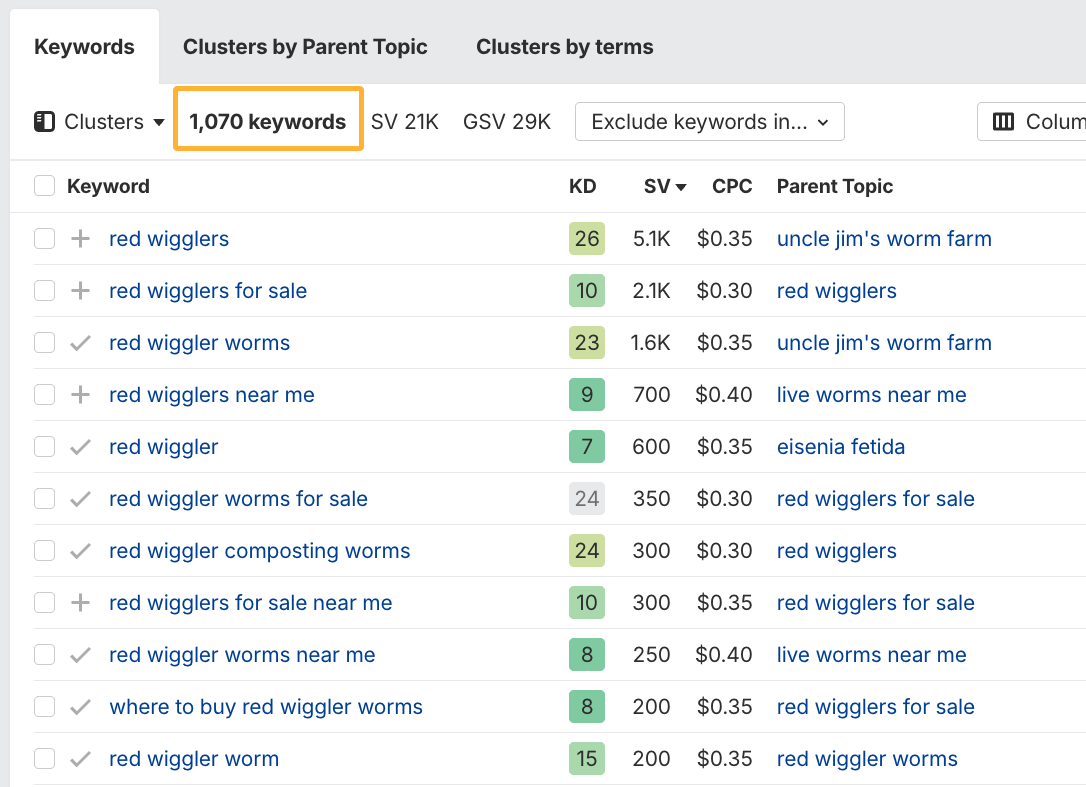
When you remove keywords that don’t match the intent of their website, there are even fewer. As far as content goes, most of these keywords can be covered in 12 to 15 blog posts, and whatever ecommerce pages match their product range.
Another small, contained topic might be a niche service, such as solution-focused brief therapy (SFBT), which also has about 1,000 keywords. But many of them have the same parent topic:
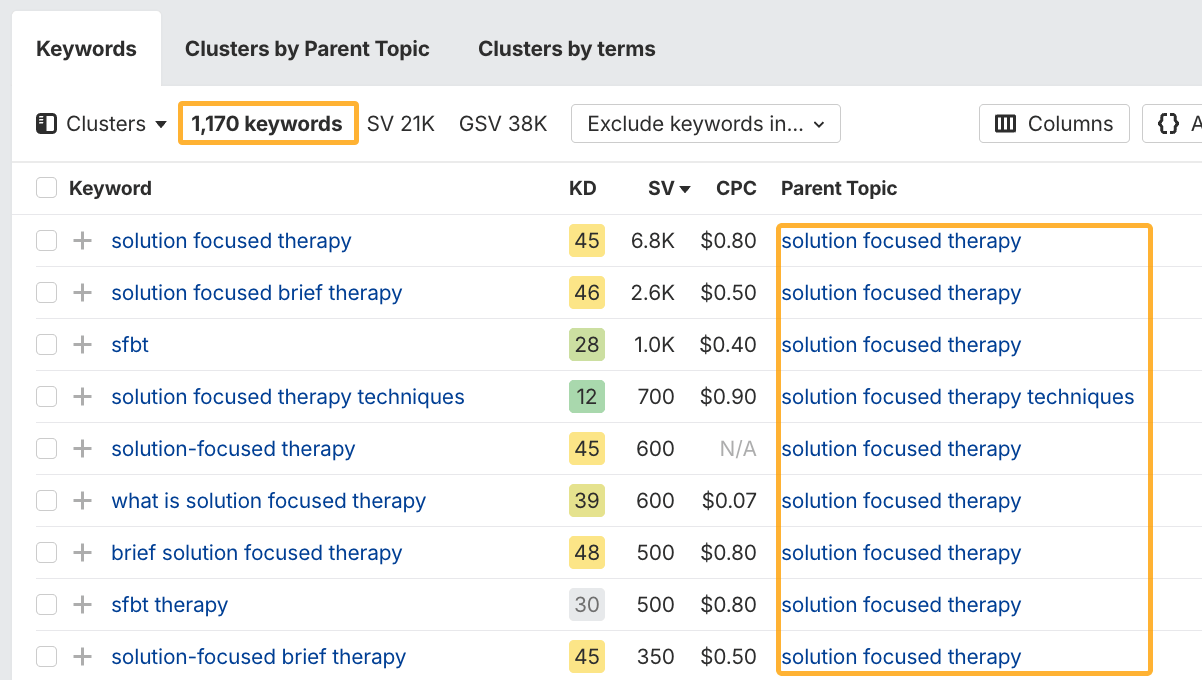
So, you could probably get decent visibility with up to 33 pieces of content (presuming all keywords and topics are aligned with your website’s intent).
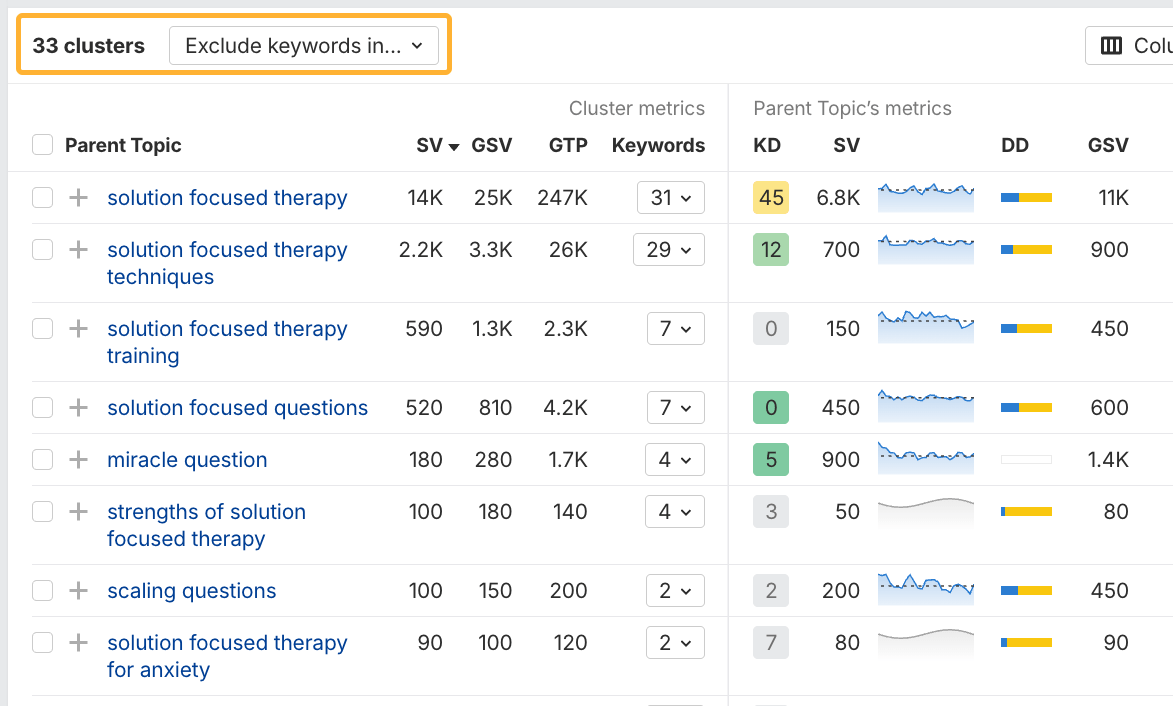
When creating content for such small keyword lists (and yes, these are small compared to the hundreds of billions of unique keywords that search engines process), you’ll reach a content ceiling.
It doesn’t take much to rank well and maintain topic leadership if you do it right.
For example, a B2B brand I worked with offered a niche product, uniforms and scrubs for a handful of professions. In this niche, there wasn’t much keyword-focused blog content we could create. No one needed to ask Google questions about the topic; it was self-evident.
So, we only needed 114 ecommerce pages covering about 2,500 keywords to become a leader for the topic in their country.
They sustained this topical leadership for about two years before they redesigned their website in-house without taking into account SEO implications (as many brands unfortunately do):
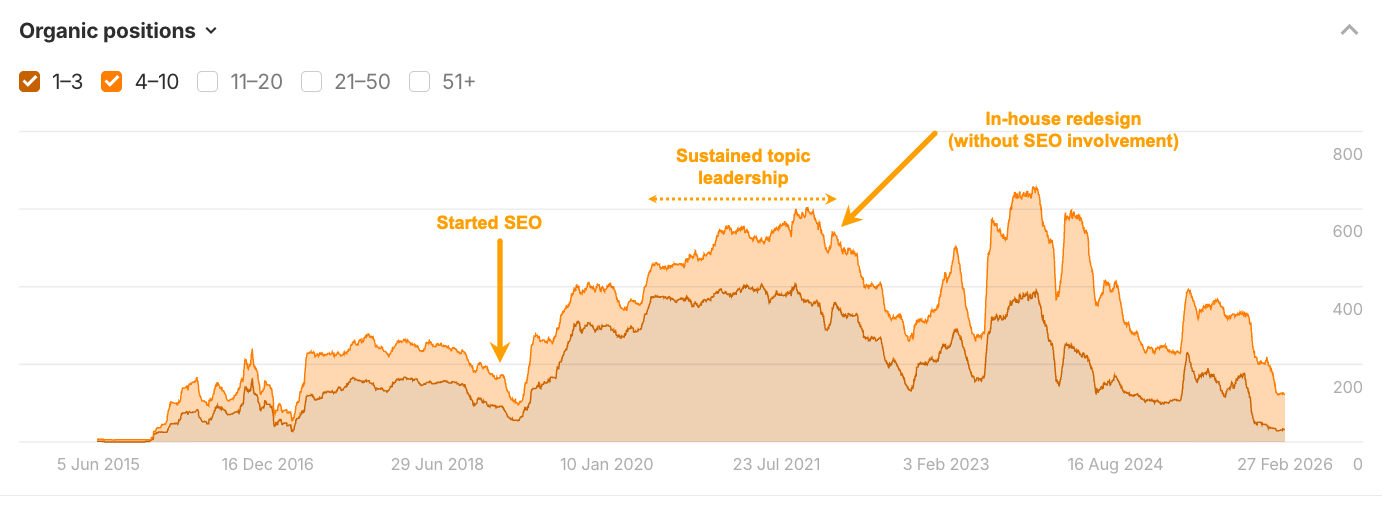
When optimizing for such small, well-defined topics, reaching a plateau when you’ve covered everything you can in your content is a sign that you’re at the peak.
Your goal here isn’t to see a hockey stick, an exponential graph, by expanding to other topics. It’s to maintain that high plateau and remain the leader for your core topic by building up your brand authority and awareness.
Key insights
When to use this approach: Your product or service is niche, the keyword universe is small, and intent is consistent across the topic. At this level, traditional keyword research works well and is easy to manage.
What success looks like:
- Comprehensive content coverage of all relevant subtopics (even if it’s only a handful of pages)
- Strong rankings across the full keyword set (even if it’s a small volume of keywords)
- Clear topical authority within a well-defined space (reaching that high plateau and maintaining it)
Where many go wrong: Many people are tempted to expand into related topics, such as moving from SFBT to therapy or from red wigglers to worm farming more generally. Don’t do this unless you’re also expanding your services or products.
It dilutes the brand’s topical focus, and you won’t be able to maintain your leadership in the corner of space that actually matters to you and delivers quality leads.
Some topics look straightforward on the surface, but get complicated fast. The keyword list is larger, intent is mixed, and the topic boundaries are genuinely fuzzy.
Think of this as the solar system tier. Multiple objects in space are orbiting different centres of gravity, and it’s not always obvious which ones belong to your topic and which ones don’t.
“Product design” is a perfect example. Type it into a keyword tool, and you’ll find a mix of queries about UX and Figma prototyping alongside queries about physical manufacturing and industrial design.
For example, in this list, the outlined keywords are about UX product design, and the highlighted ones are about designing physical products. The rest are ambiguous and can frequently switch meaning and intent in search engine results:
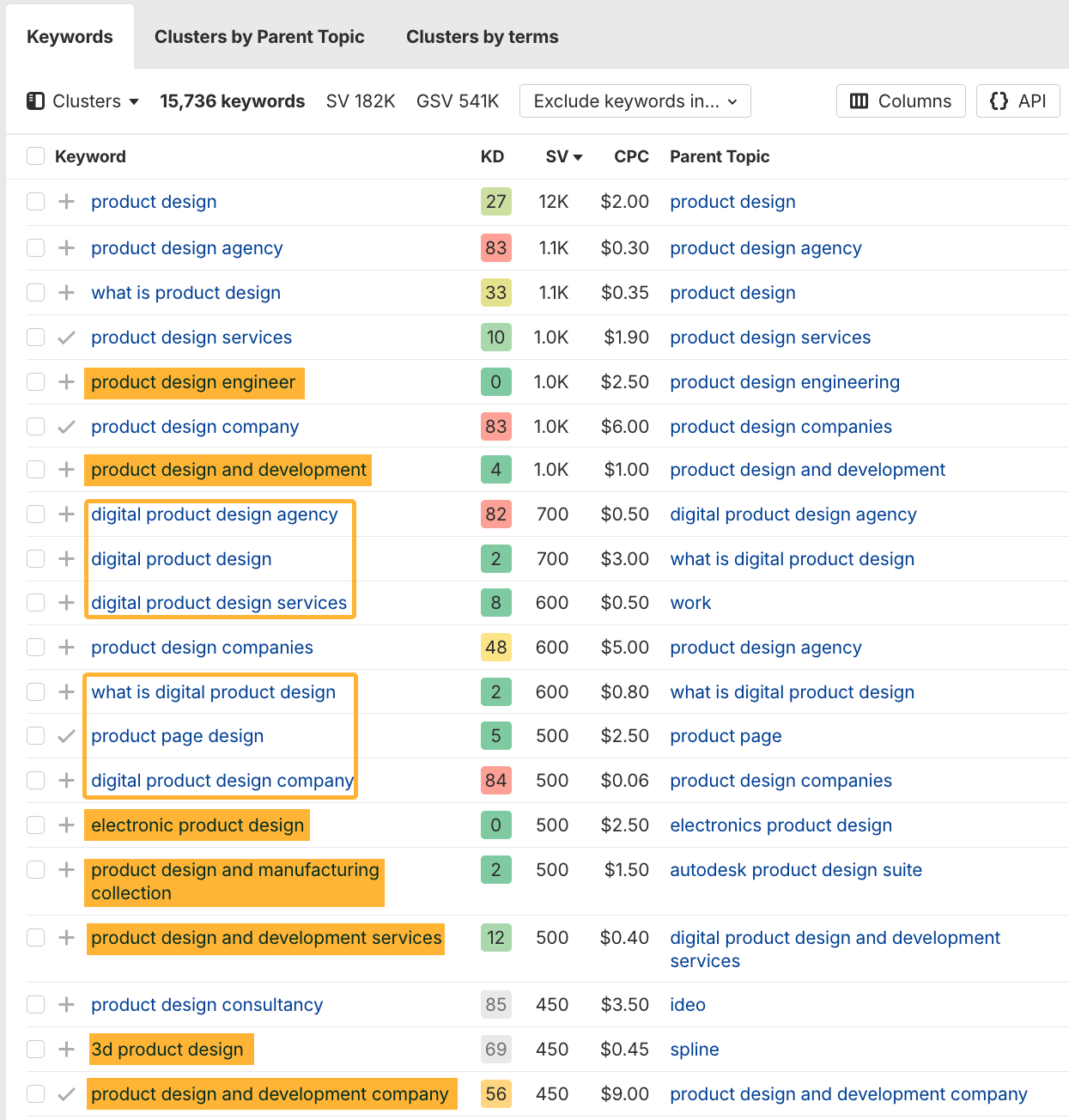
The keywords are difficult for both humans and machines to clarify:
- On a word (lexical) level: The words used are exactly the same and simultaneously mean both things.
- On a meaning (semantic) level: Even surrounding words that are used to extract more meaning can be confusing, e.g., digital vs electronic. In this case, electronic applies to physical products only.
- On a topic or entity level: The brands associated with product design are the biggest differentiator. Figma, Spline, and Miro relate to UX product design, whereas Ideo and Autodesk are for physical product design.
This isn’t just an SEO problem. Not understanding these nuances can cost brands thousands in wasted ad spend, too.
This is the search equivalent of the Pluto debate.
Some keywords look like they belong in your topic cluster, but when you understand the full semantic neighbourhood around them, they’re connected to a different topic, intent, or meaning entirely. Just like astronomers needed better criteria to define what counts as a planet, you need better signals than keyword volume to define what belongs in your topic.
You won’t be able to own the full topic due to the prevailing ambiguity, but you can still become a leader in the parts relevant to your brand.
Key insights
When to use this approach: Your topic has multiple interpretations, mixed intent, or overlapping audience types that require disambiguation.
What success looks like:
- Clear topic boundaries and keywords filtered to remove ambiguous or off-topic terms
- Content that speaks unambiguously to your specific audience
- Rankings that attract the right visitors who convert instead of bouncing
Where many go wrong: There is a lot of detail and nuance involved in mapping keywords correctly for ambiguous or complex topics. If you aren’t treating it as a semantic SEO exercise and just looking at keyword volume, you’ll be optimizing for totally unrelated things and diluting your topical authority significantly.
Some topics have no boundaries at all and are ever-growing because searchers ask many new and evolving questions, or AI search platforms continuously generate new queries through query fan-out.
Sometimes, it’s not the topics themselves that are ever-growing, but a brand’s reach across multiple topics. For example, authority sites like Forbes or Hubspot cover many topical domains in their content. Or marketplaces like Amazon, Etsy, or Airbnb unlock new keyword opportunities as new products get added.
Coming back to our space analogy, these topics are like galaxies.

A small keyword list for topics like this is in the hundreds of thousands. Though in most cases, you’d be looking at covering millions of keywords in your content and SEO strategy.
At this scale, your keyword universe is vast, ever-growing, and impossible to map manually.
New queries emerge constantly. So the focus is not on mapping every keyword, but understanding the structure (patterns and clusters) that emerges from your keyword data. Then you can focus on building content that belongs within it at a structural level.
For example, Healthline currently shows up for:
- 4.2 million keywords on Google
- 1.1 million queries in AI Overviews
- 395,000 prompts on ChatGPT
- 176,000 prompts on Perplexity
- 49,900 prompts in Gemini
- 40,400 prompts in Copilot
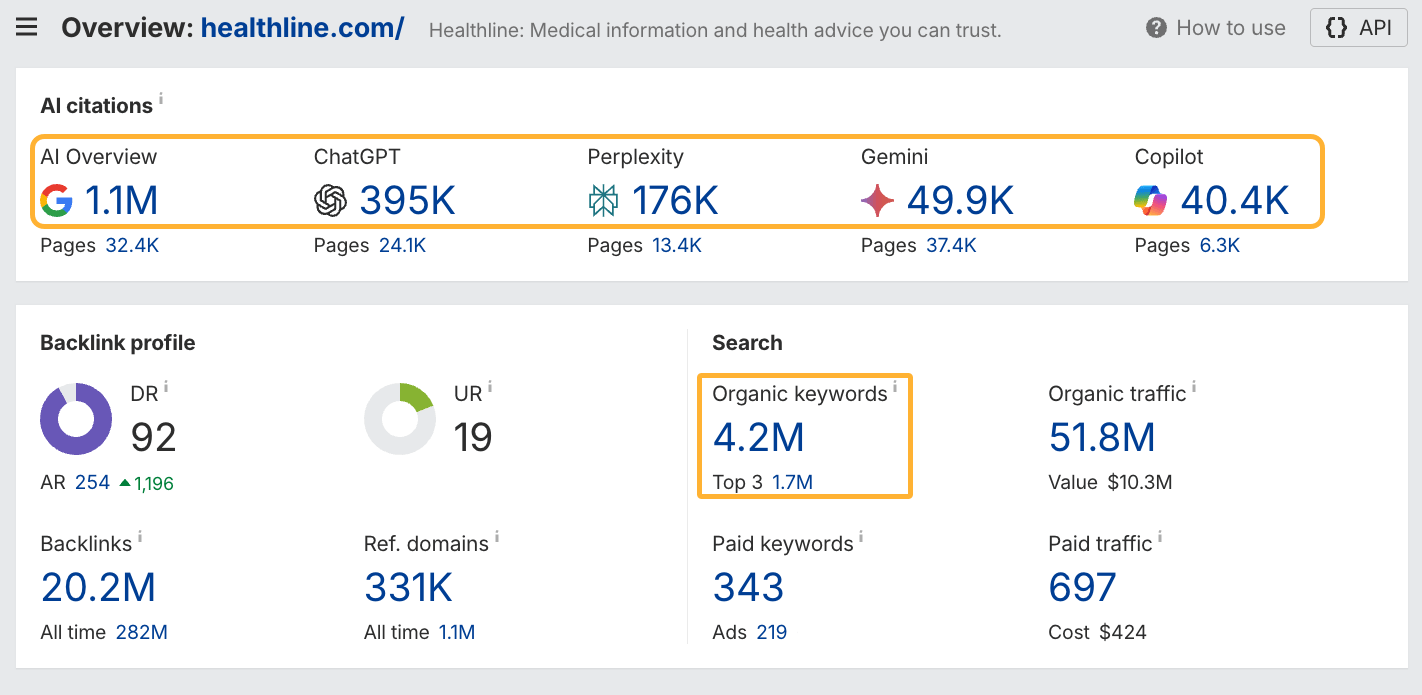
Millions of people search for health-related answers every day. They ask questions about symptoms, conditions, treatments, medications, and vague queries they use to try to self-diagnose.
Healthline’s visibility comes from understanding these patterns rather than manually targeting individual queries. It prioritizes structural topical coverage by building a resource that search engines recognize as an authoritative home for health questions across entire medical subject areas.
For instance, it has different content pillars for health, nutrition, fitness, common conditions, and more:
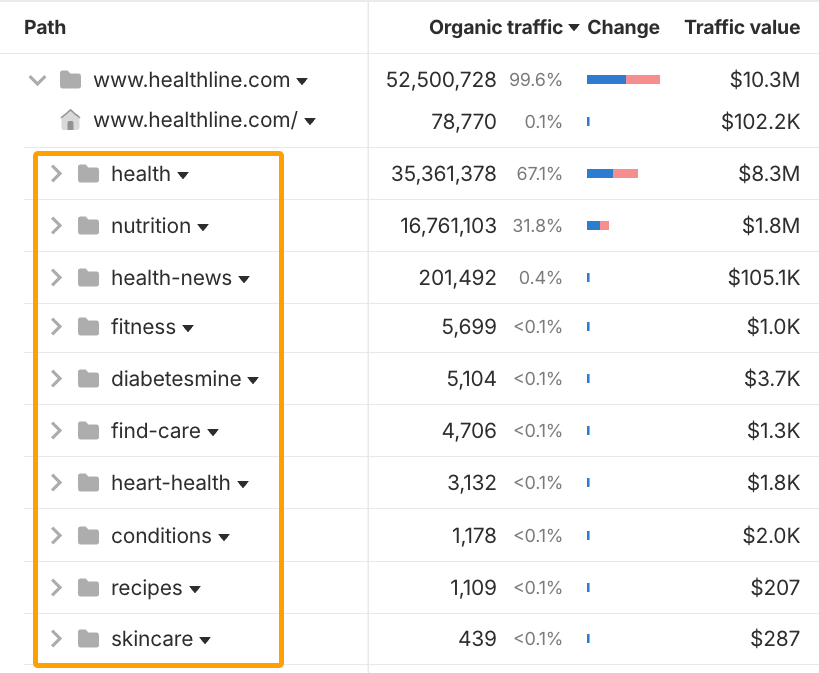
The content in each pillar follows a repeatable format that ensures adequate topic coverage, even if it doesn’t squeeze in every relevant keyword (as many SEOs try to do).
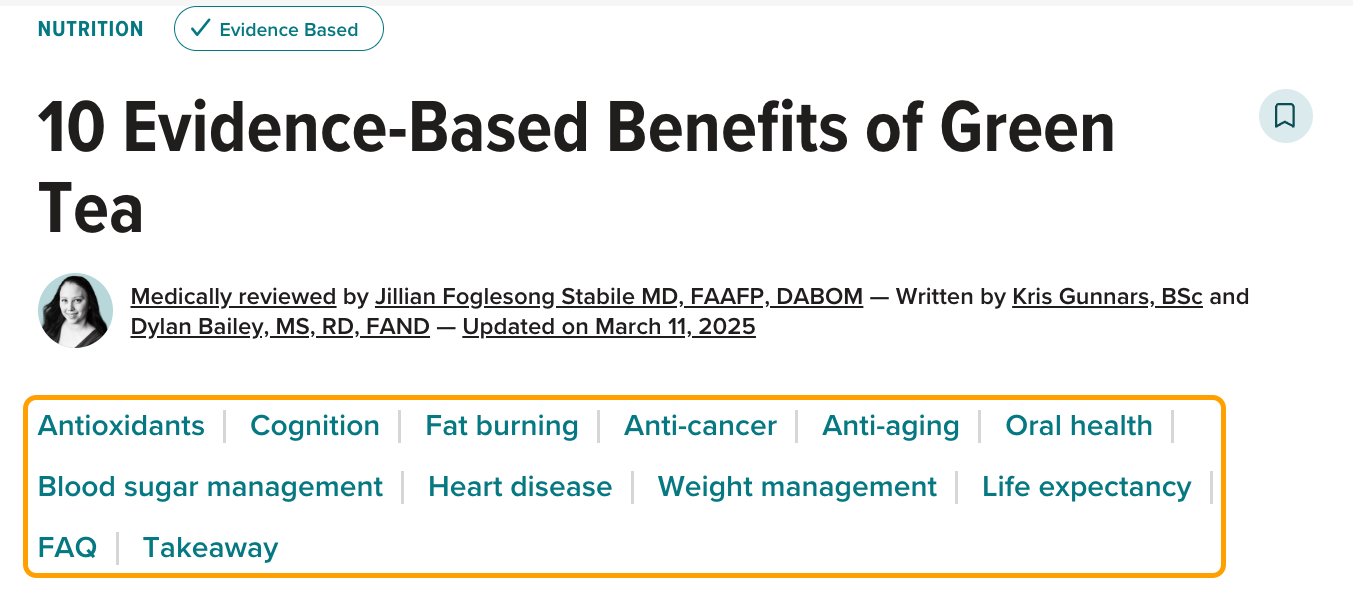
By structuring content this way, Healthline can create a single page for each relevant sub-topic. For instance, it’s page about magnesium glycinate shows up for:
- 2,500 keywords on Google
- 473 queries in AI Overviews
- 279 prompts on ChatGPT
- 200 prompts on Perplexity
- 28 prompts in Gemini
- 86 prompts in Copilot
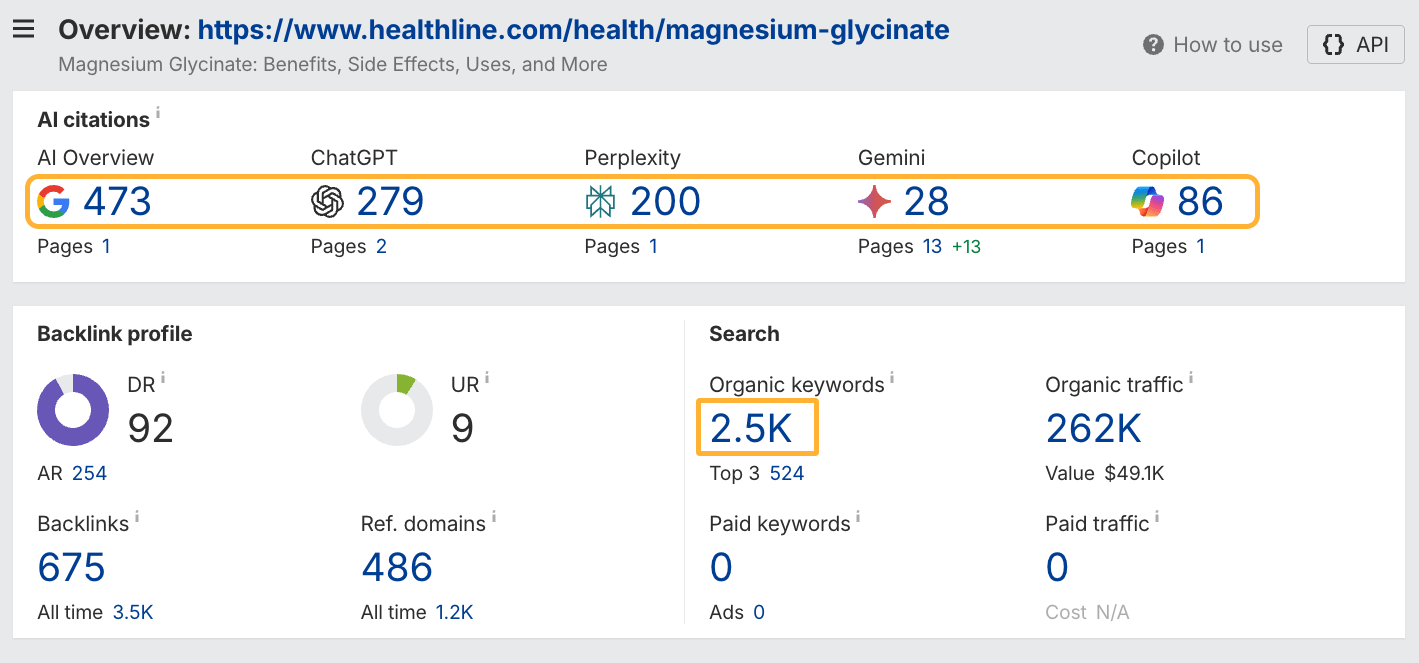
The page contains about 1,000 words of content (in the main body of the article). It is impossible to include all the keywords it ranks for in the article.
In contrast, Oreate AI optimizes content for specific keywords, leading to over 60 pages that contain magnesium glycinate in the URL, each one only ranking for a handful of keywords:
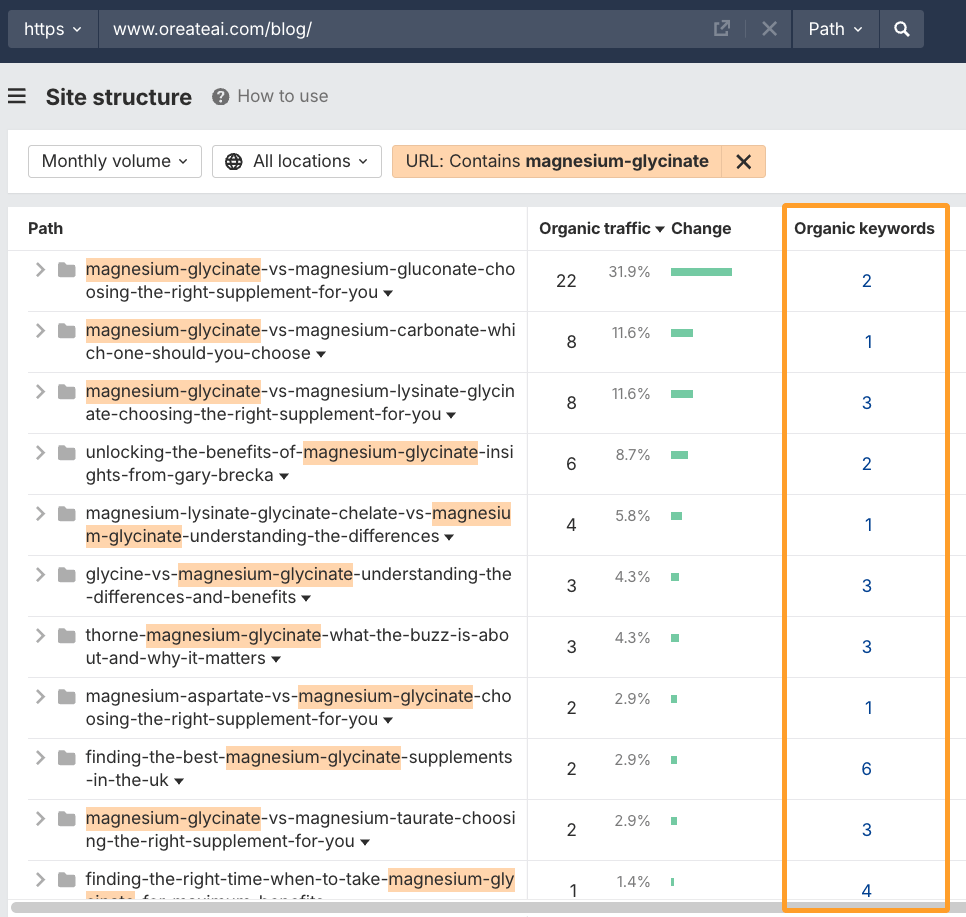
In total, Oreate AI ranks for 266 magnesium glycinate keywords across 208 pages. 200 times Healthline’s content creation efforts for a tenth of the keywords (give or take).

Sure, there are other factors at play here (like brand authority and website age). Yet, this contrast reveals how topical authority actually works.
Healthline earns more visibility per page because it has earned its authority for health-related subjects. Visibility follows a brand’s topical authority, not the other way around.
You can do the same for each content piece you publish with Ahrefs’ AI Content Helper. It helps you select a specific intent to optimize for…
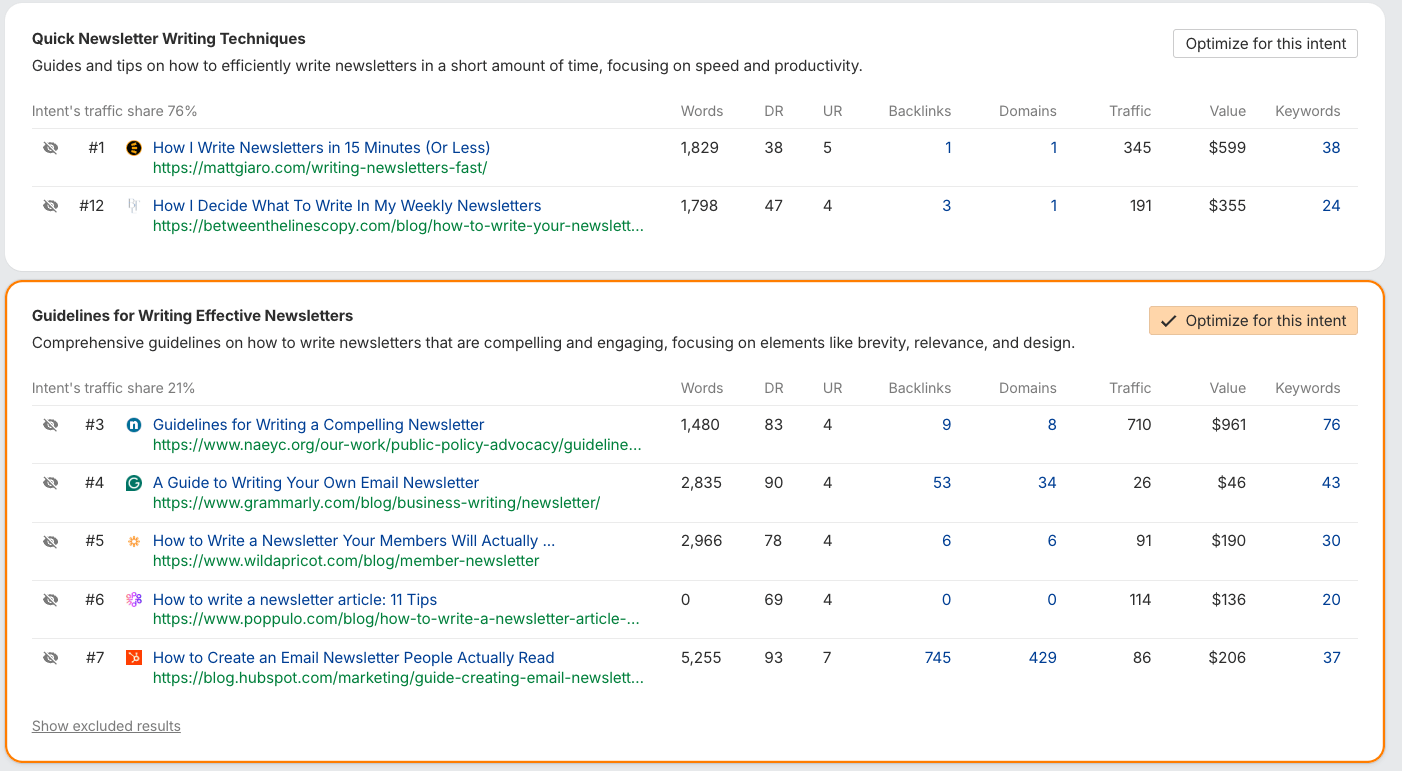
… and then breaks down all the relevant sections and topics you need to include in your content, scoring your topic coverage along the way.
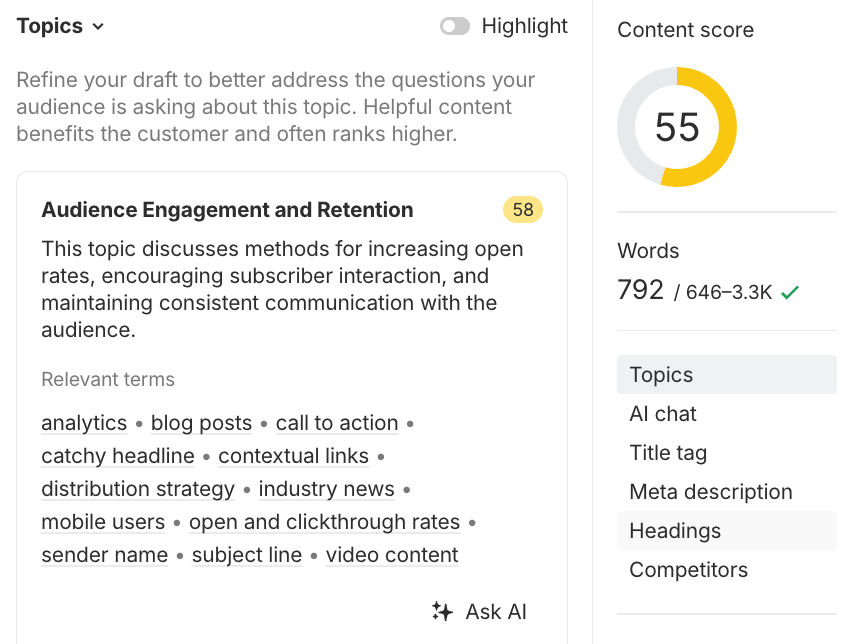
But when it comes to knowing what content you need to create to begin with, for expansive topics, traditional keyword-by-keyword research gives way to pattern recognition across large datasets. This is where AI tools and the Ahrefs MCP start to become genuinely powerful (which we’ll get to shortly).
Key insights
When to use this approach: Your topic is vast, your audience generates an endless stream of queries, and manual keyword research can’t keep pace with the scale.
What success looks like:
- Coverage of the major sub-topics your audience cares about, not an exhaustive list of individual queries
- Growing keyword breadth over time as new queries and search patterns emerge
- Authority that compounds as your website becomes the authoritative home for all topics it covers
Where many go wrong: At this scale, trying to plan and track content keyword by keyword becomes counterproductive. The goal is to build the kind of structural coverage that earns authority across your whole keyword universe.
Brands that treat expansive topics like a bigger version of Tier 1 (just more pages, more keywords) miss the point entirely. Pattern recognition and topical architecture matter far more than any individual piece of content.
Knowing the difference between keywords and topics is one thing. Putting it into practice is another. The following process gives you a framework for defining the territory your brand wants to own and choosing the right approach for your topic.
It’s designed to work whether you’re a niche business covering a small, well-defined topic or a large publisher navigating an expansive keyword universe. The principles are the same; the scale and tools differ.
Step 1: Start with your brand lens
Define the topic territory that matters to your brand before you look for a single keyword.
This is the most important step and the one most people skip. Without a clear brand lens, keyword research becomes a list of opportunities with no filter, and you end up chasing topics that attract traffic but not customers.
Start by auditing what you already rank for using Ahrefs Site Explorer and checking out the Organic Keywords report:
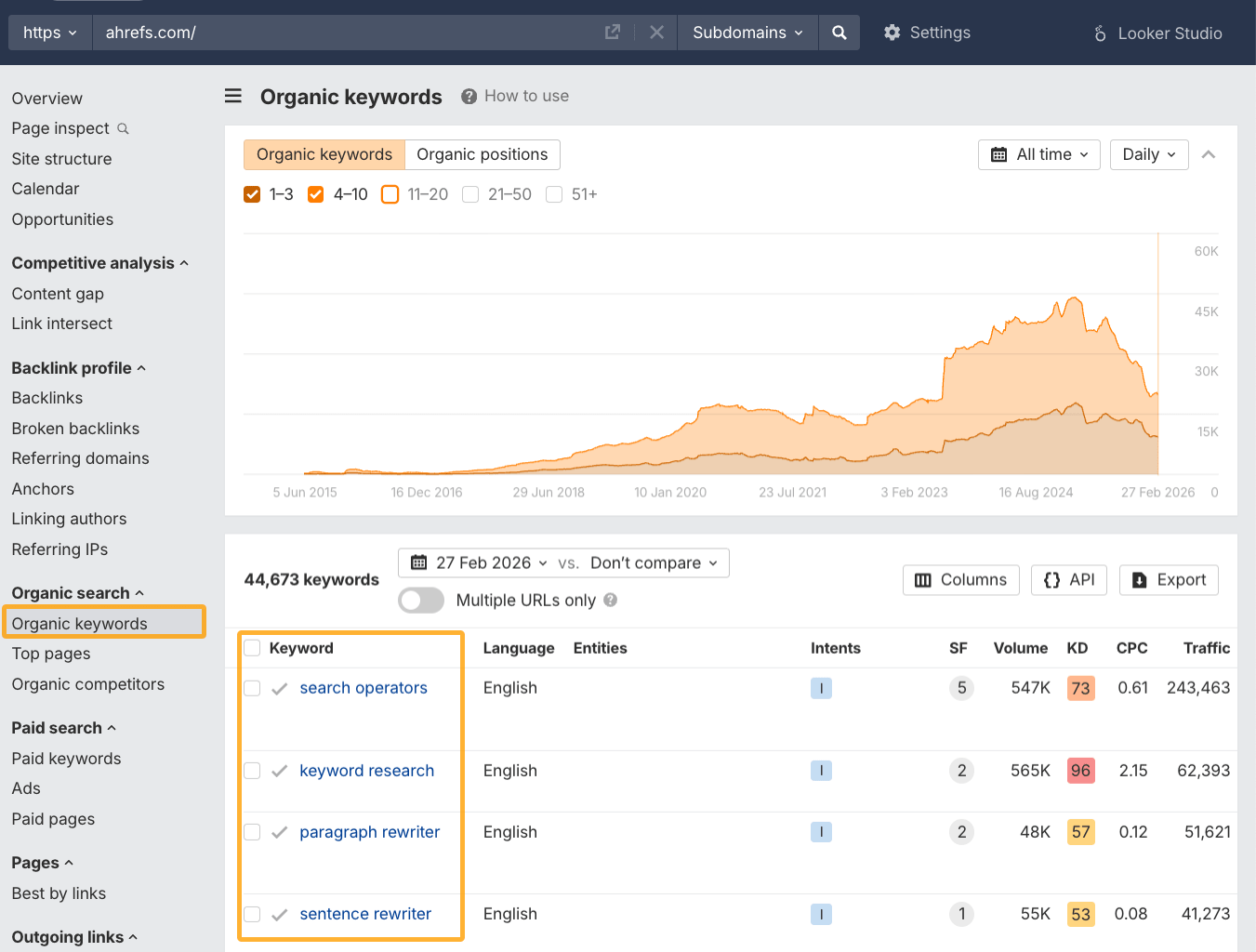
This shows you what search engines already associate with your brand and the topics you’re closely connected to.
Then, layer in what you actually know about your business:
- What are your product and service categories?
- What pain points do your customers come to you with?
- Where are competitors playing, and where are the gaps?
- What questions do customers ask at each stage of their journey?
Asking these questions often surfaces gaps. For example, you might notice that search engines have misinterpreted the topics you want to be connected to, in which case you’ll need to work on disambiguation your brand.
For example, IDEO is a product design firm known for its human-centered design philosophy. It produces physical products but ranks for terms about digital product design:
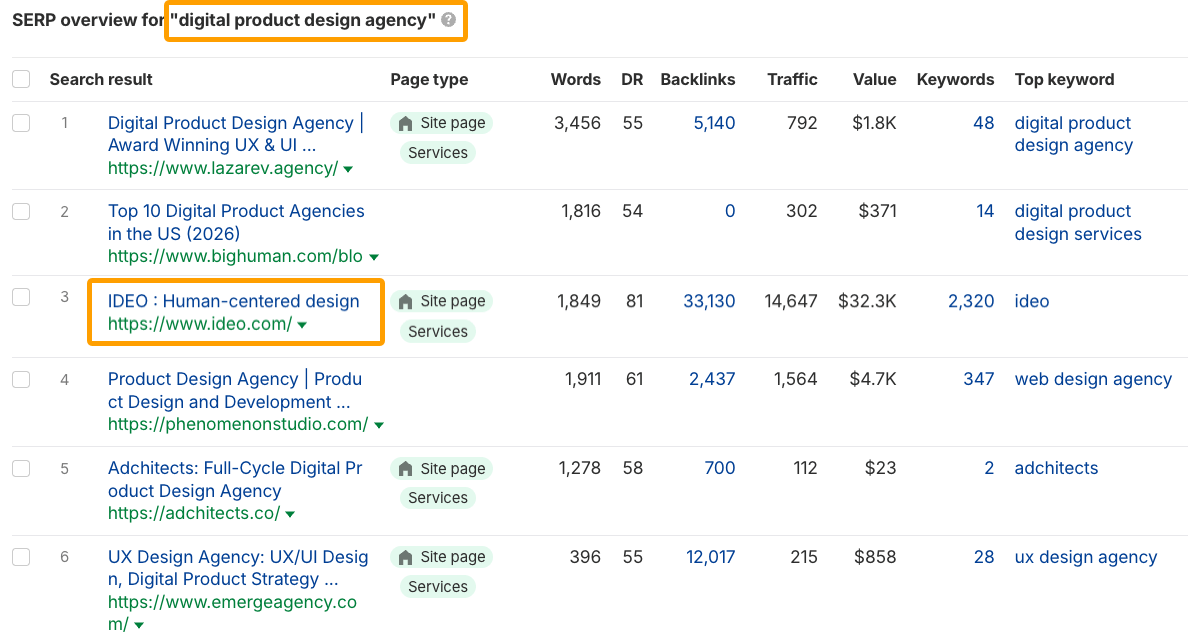
You might notice similar ambiguities for your brand. Or you might notice that search engines have yet to connect you to a core product category, in which case you’ll need to focus on closing the gap.
You can also use the following filters to define and pressure-test your topic boundaries before committing to them. These are excellent if you’re starting a new brand and don’t have existing performance data to work from:
- Topic meaning: Does your topic have one clear interpretation or multiple? e.g. “product design” splits between UX/digital and physical/industrial. Half the keyword universe may belong to a different audience entirely
- Intent alignment: Is the intent informational, commercial, or transactional? e.g. “phone cases” is almost entirely transactional as there’s little informational content you can rank for that will actually drive relevant traffic
- Content format capabilities: Can you actually create the type of content that ranks for this? e.g. a local plumber can’t compete for keywords dominated by directory listings or comparison sites
- Product/service scope: Does this topic connect to something you can deliver? e.g. a personal injury law firm covering general legal advice topics that attract people with problems they can’t solve
- ICP relevance: Does it serve your ideal customer, or just any visitor? e.g. a B2B SaaS brand ranking for generic “what is a spreadsheet” queries with high traffic, zero conversion potential
- Business potential: Is there real return on investment, conversion likelihood, or strategic value here? e.g. a luxury brand ranking for budget-focused keywords attracts browsers, not buyers
This exercise alone will save you months of effort on the wrong topics, and in this case, it also tells you exactly which tier you’re dealing with before you write a single word.
Step 2: Choose your optimization approach
Once you’ve defined your topic territory, the next decision is how to approach it. This comes down to two things: the complexity of your topic, and your brand’s goals for owning it.
That’s exactly what the three tiers above are designed to help you decide. Go back and identify which tier your topic belongs to, then follow the approach that fits.
To put it simply:
- Tier 1 topics need thorough, complete coverage of a small, well-defined space. The goal is to reach the plateau of topic leadership and hold it.
- Tier 2 topics need semantic clarity before content planning. Disambiguate intent first, then build content that speaks unambiguously to your specific audience.
- Tier 3 topics need structural coverage and pattern recognition across a large dataset. This is where AI tools become genuinely useful.
For Tier 1, you can build a list within Ahrefs Keywords Explorer. Enter your main topic(s) into the search bar and check out the matching terms report to expand your keyword list:
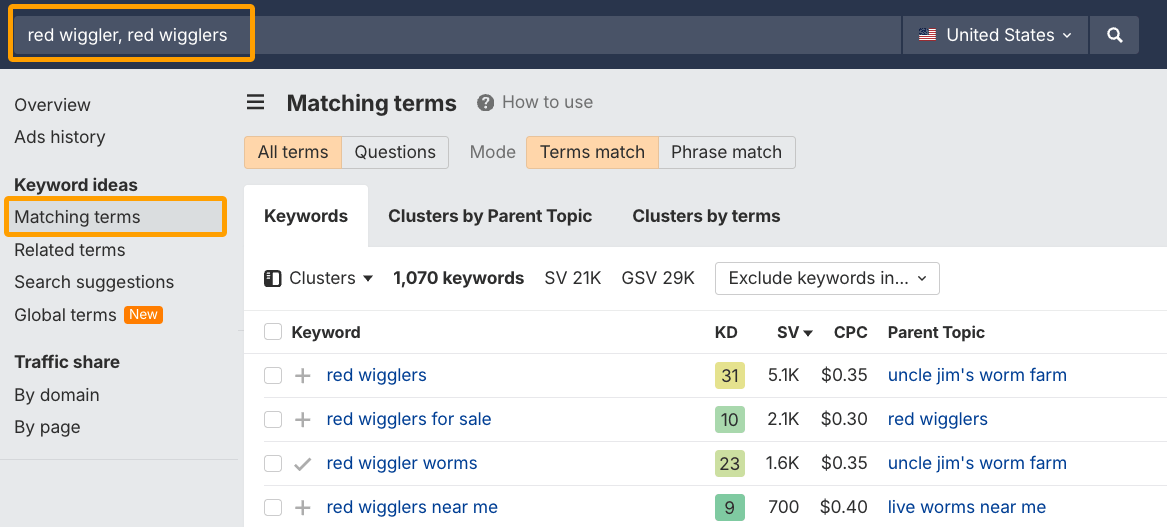
Then select the keywords that align with what you do and build your keyword list.
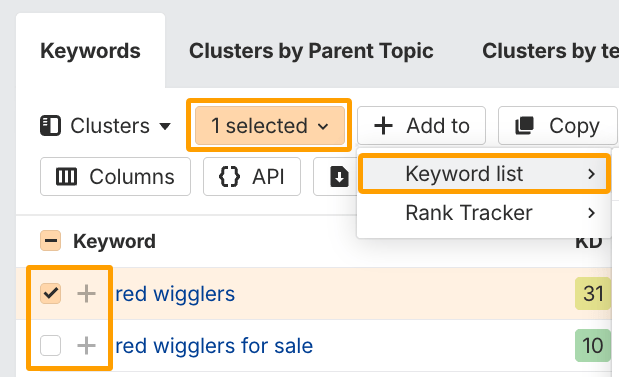
You’ll often come across keywords you’re unsure about.
In these cases, click on the SERP dropdown to see what types of pages already rank. You can use the AI feature to identify the dominant intent they cover. You can also perform a manual check to see if the ranking pages are similar to what you can create for your website.
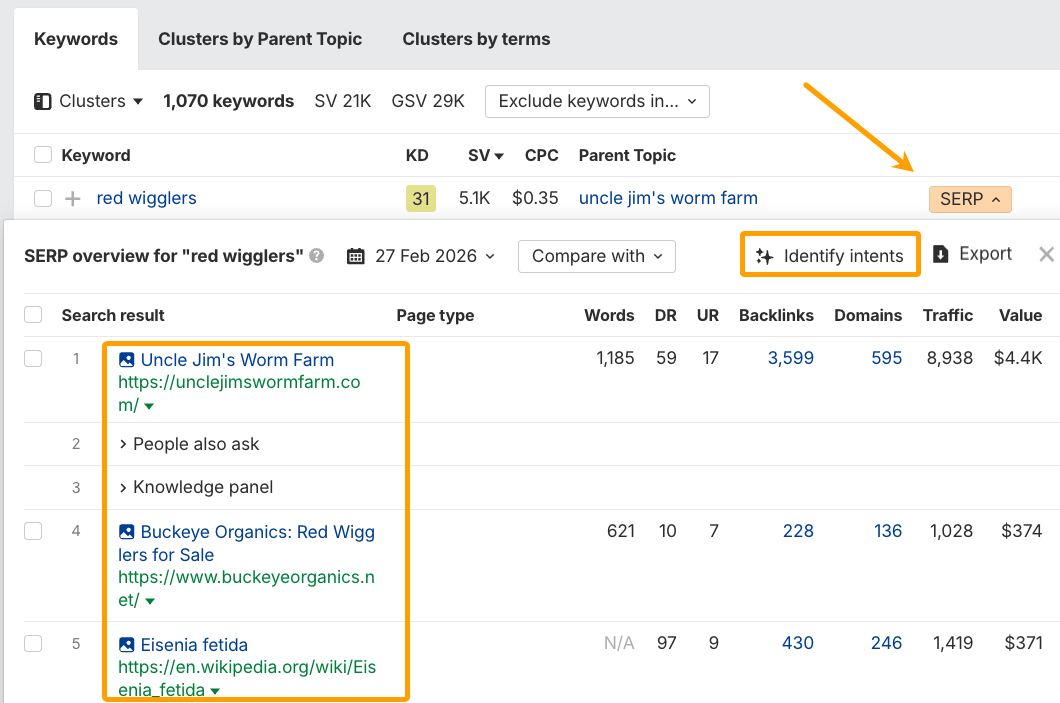
If you think you can create similar content to cover the keyword and its intent, add it to your list:
For Tier 2 and especially Tier 3 topics, the Ahrefs MCP, combined with Claude, can significantly accelerate your topic-mapping process.
You can export keyword data in bulk from Keywords Explorer in CSV format or use the Ahrefs API:
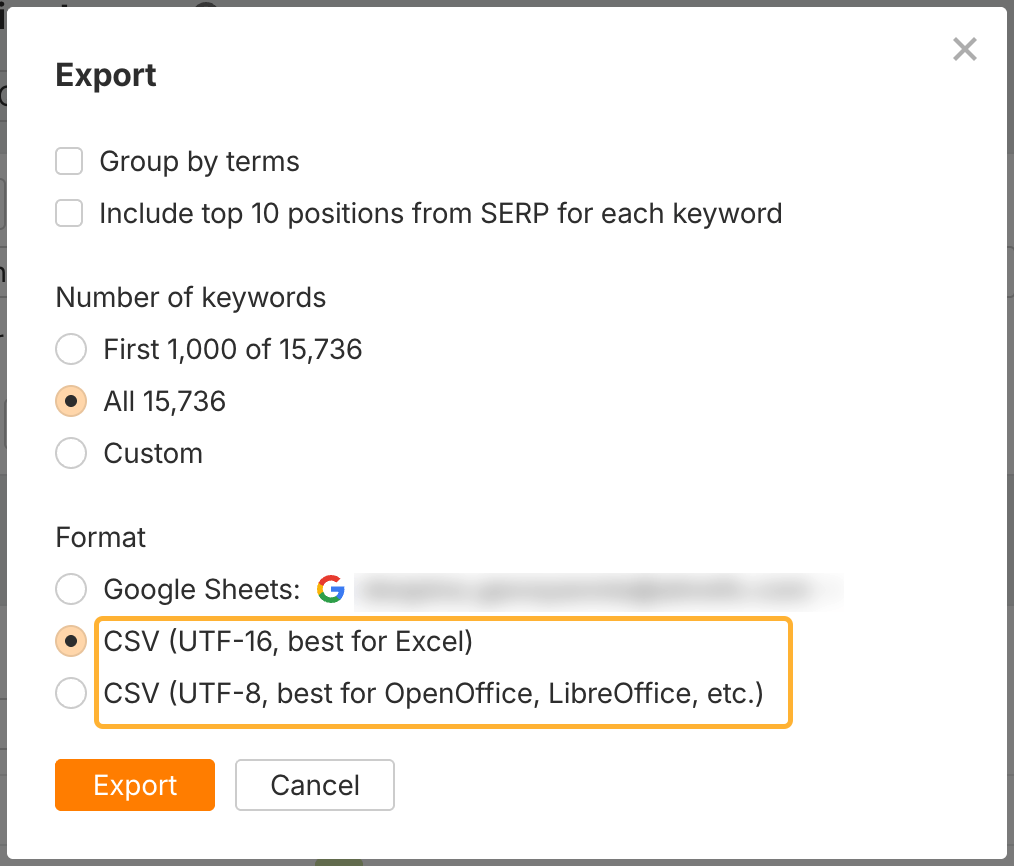
Then, ask Claude (or your preferred LLM) to cluster it into semantic groups by intent and context. Our team has consistently achieved better results with Claude than with ChatGPT, but your mileage may vary. It all depends on the models, prompts, and workflows you’re using.
You can also use the Ahrefs MCP within your preferred LLM to identify gaps. These are terms related to your topic that aren’t on your list yet.
The Ahrefs MCP use cases guide and setup docs are the best places to start if you haven’t used it before.
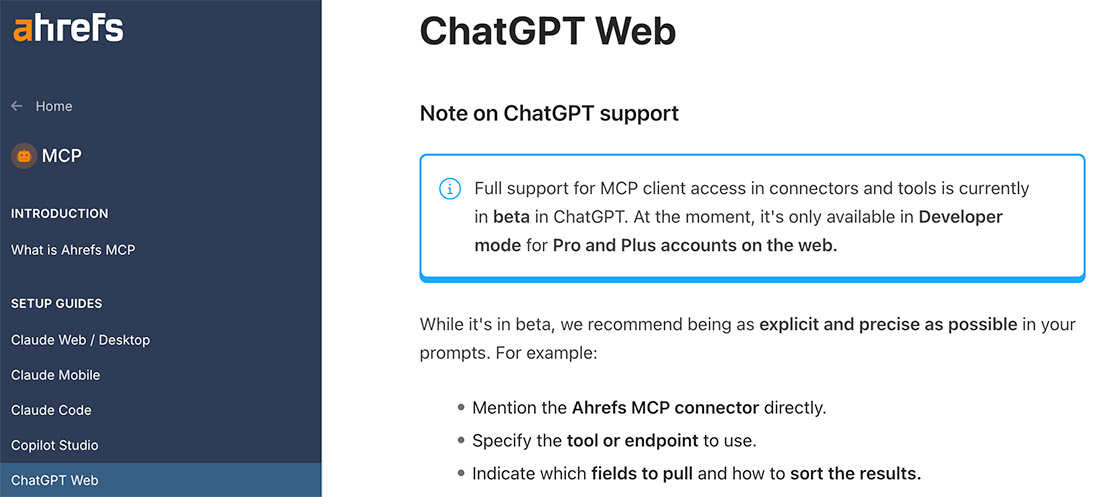
A few things that consistently improve results when prompting LLMs for keyword clustering and topic mapping:
- Give specific examples of what a good cluster looks like for your niche
- Let the LLM decide the number of clusters rather than forcing a fixed count
- Exclude branded terms and years from the output
- Focus on keywords of three or more words where possible, since shorter terms cluster too broadly
- Expand one specific cluster at a time rather than asking for everything at once
With the MCP and API, you can build and manage keyword universes containing millions of keywords. You can also find the hidden structural patterns that semantic search engines use and build your content plan around those.
Once you’ve worked through your whole keyword list, start creating content. For smaller projects, you might do this manually with the help of content editors like AI Content Helper:
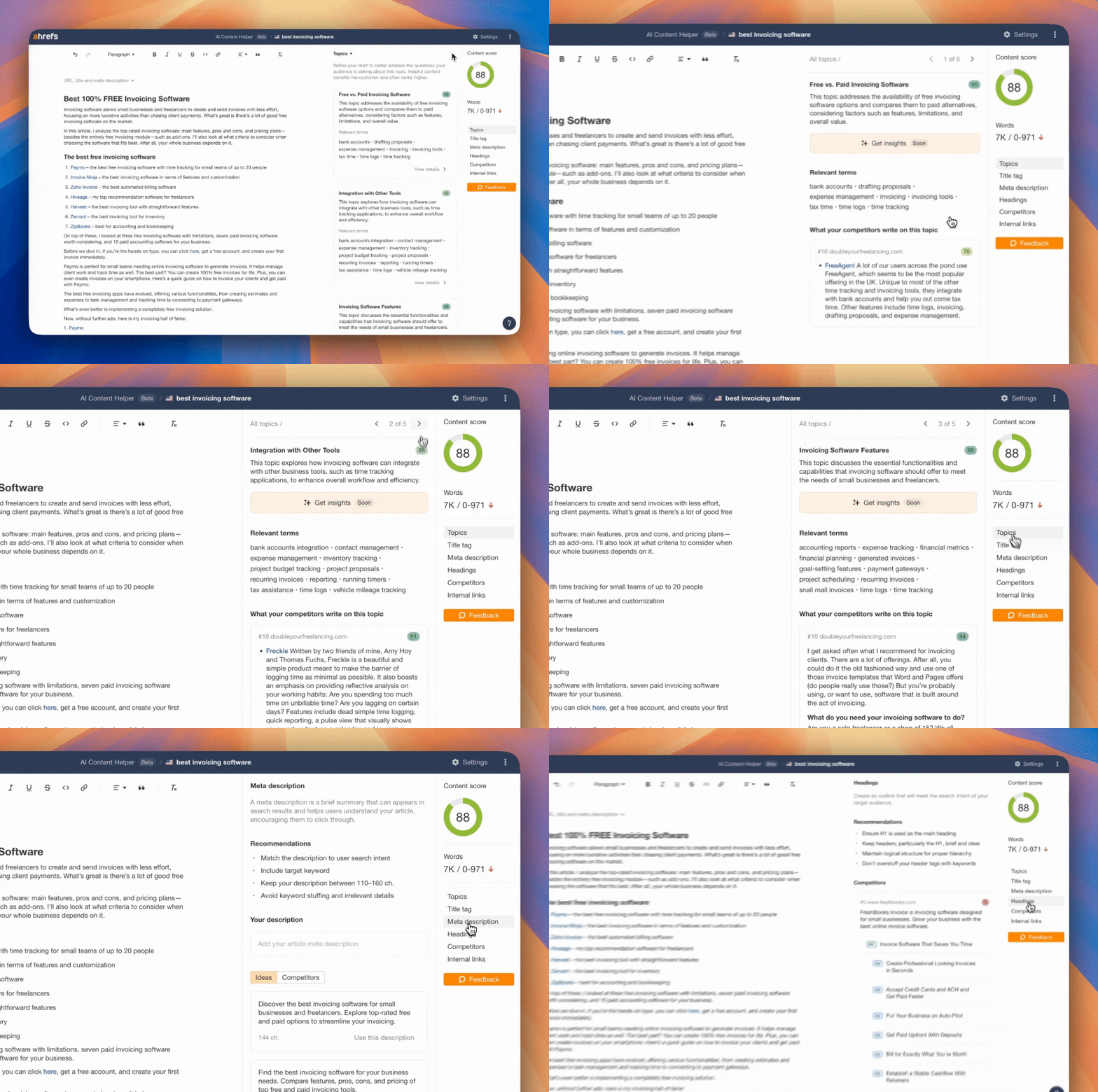
For larger websites, you may build these pages out programmatically. And if you’re using a headless CMS, you can build content models for common page types to help.
Step 3: Measure your topic coverage
Individual keyword rankings tell you how one star is performing. Topic coverage tells you how much of the solar system or galaxy you own.
Track progress using metrics that reflect the bigger picture, not just position tracking for individual queries. Ahrefs Brand Radar is built for exactly this. You can use it to monitor:
- Query breadth: How many related queries and prompts are you visible for in AI search, and is that number growing?
- Share of Voice: What percentage of total topic visibility does your brand own?
- Coverage expansion: Are you capturing more of the topic space over time?
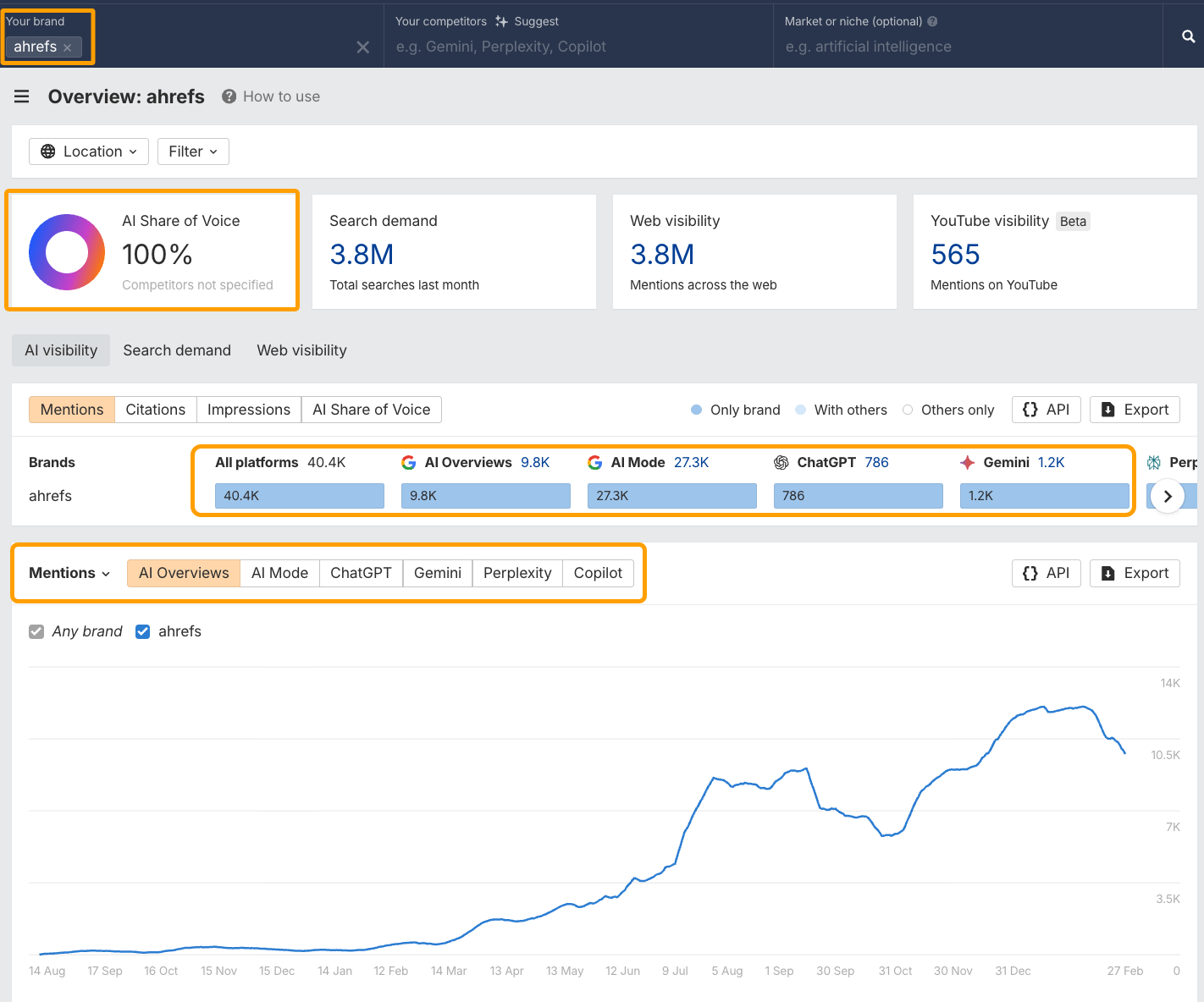
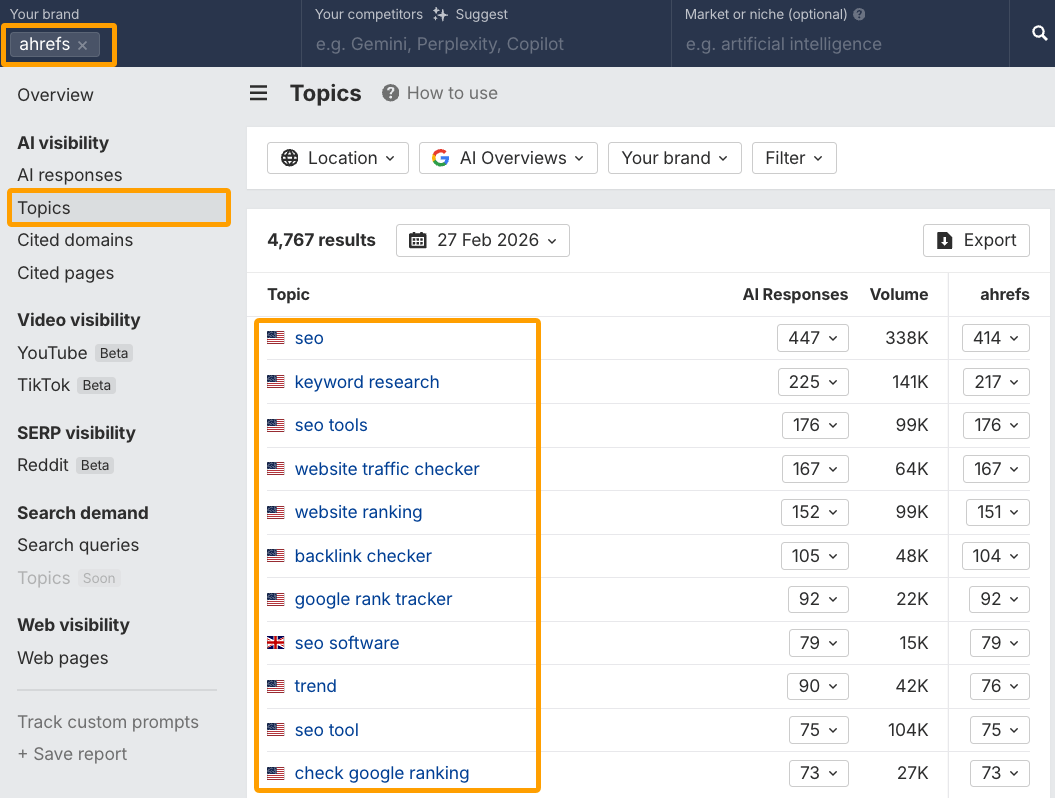
It is also a great tool for topic exploration. You can see exactly what topics semantic and AI search systems associate with your brand in the Topics report:
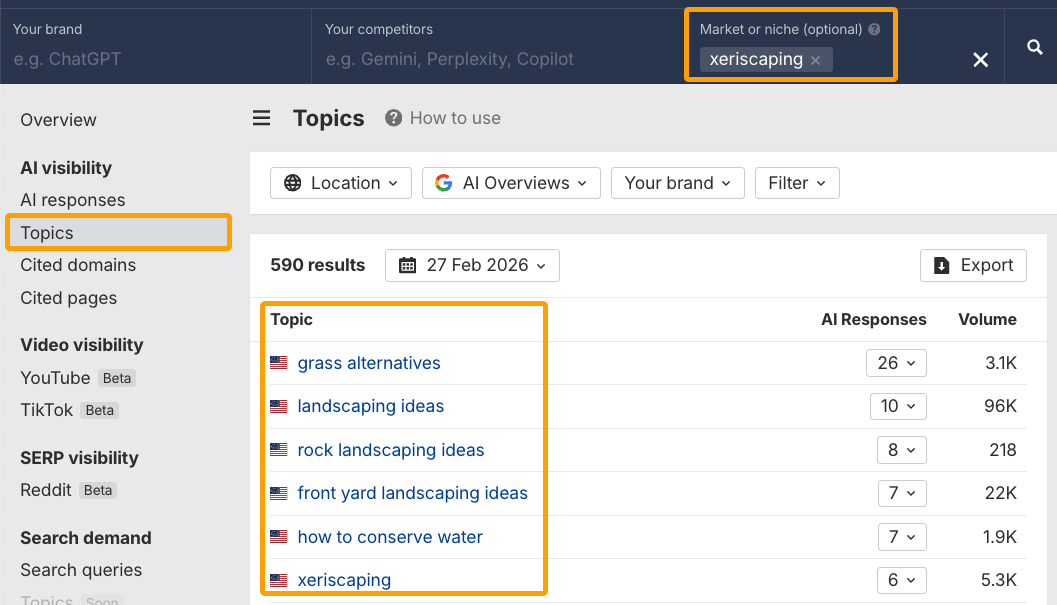
You could also search for your main topic (without your brand) and explore what sub-topics are included in it by AI systems:
The goal isn’t to rank #1 for every keyword (even the biggest brands don’t achieve that).
Instead, aim to own the topic space that’s most relevant to your brand and be recognized as one of the most authoritative sources for it. Watch for growth in keyword breadth and Share of Voice, including AI Share of Voice, as answer engines become an increasingly important part of how people find information.
Final thoughts
Keywords aren’t going anywhere. But the way you use them needs to change.
Stop treating them as individual ranking targets and start treating them as coordinates and signals that collectively map the topic space your brand wants to lead. The goal is to be the most trusted, deeply connected source for the topics that matter most to your audience.
Topic optimisation turns keyword research from a list-building exercise into a long-term strategy for authority.
And in a search landscape increasingly shaped by AI, the brands that own their topic galaxy (not just a handful of stars within it) are the ones that will keep winning visibility.